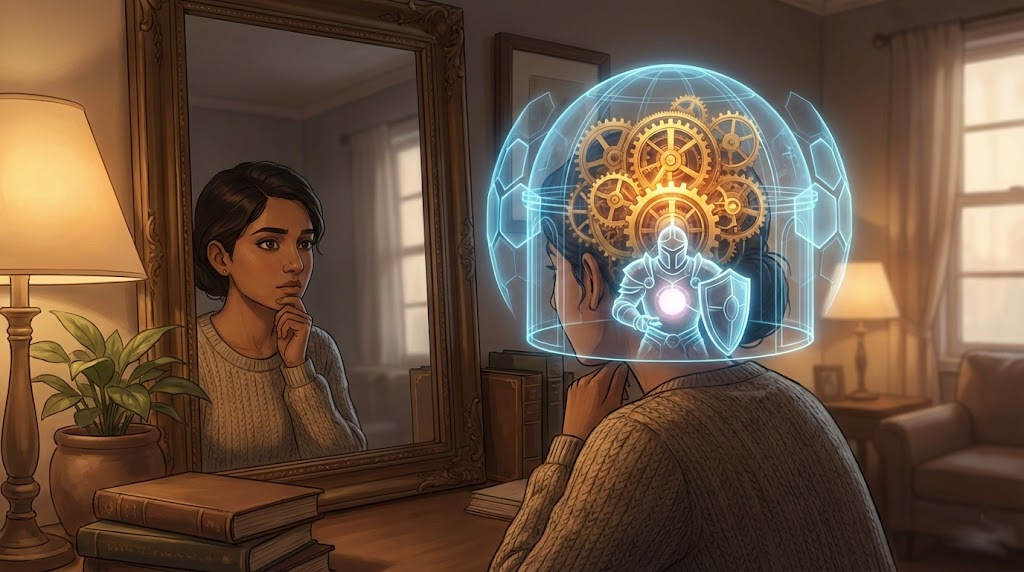
Have you ever felt like your own brain is your biggest enemy?
You sit down to work on an important goal, and instead of focus, you’re hit with a wave of tiredness so heavy you can’t lift a finger.
You’re in a relationship that’s going well, but you find yourself picking a fight over something trivial, sabotaging the very connection you crave.
You know you need to make a decision, but your mind spins in an endless loop of “Why?” Why do I feel this? Why did they do that? Why can’t I just be normal?
Or perhaps, you feel a rising panic when things aren’t perfectly planned. The slightest change in schedule sends your heart racing. People call you a "control freak," but inside, it doesn't feel like control—it feels like the desperate grip of someone trying to keep from drowning in chaos.
In these moments, the conclusion feels obvious and painful: A part of me is broken. It’s working against my own best interests.
What if you’ve been misunderstanding the message? What if that “stuck,” “sabotaging,” or “paralyzed” feeling isn’t a sign of a broken part, but of a brilliant, overworked protector doing its job with outdated instructions?
📋 Quick Navigation
The Protection Hypothesis: Your Mind's Security System
Imagine hiring a security guard after a terrible break-in at your home. His sole directive is: “Never let that happen again.”
He doesn’t care about your dinner party plans (your goals for connection). If a guest looks even slightly unfamiliar (a new social situation), he’ll bar the door. He doesn’t care about the beautiful new window you want to install (a career opportunity). If installing it requires opening the wall, he’ll veto it—too much vulnerability.
He’s not a jerk. He’s excellent at his specific job: preventing a repeat of The Break-In. The problem is, he’s using the blueprints from the worst night of your life to run the security of your present-day home.
- The Procrastinator/Freezer Part is that guard, locking the door to the job application because the interview room looks, to him, identical to the principal’s office where you were once shamed.
- The Self-Saboteur Part is that guard, starting a pre-emptive fight in your relationship. In his logic, if he forces you to leave first, you can’t be abandoned—a painful strategy that protected a much younger you.
- The "Why?" Overthinker Part is that guard, flooding the control room with analysis and questions. As long as the system is busy “understanding,” it doesn’t have to feel the terrifying, overwhelming emotions waiting in the basement.
- The Controller Part is that guard, trying to blueprint every minute of your day. Chaos was once synonymous with danger; his frantic planning is an attempt to build a predictable, and therefore “safe,” world.
They aren’t flaws. They are highly specialized survival programs, running perfectly based on old data.
The Bridge to Curiosity: Listening for the Logic
The shift from frustration to healing begins with one simple change: we stop judging the protector’s action and start decoding its mission.
Try this: The next time you feel that familiar “stuck” or “self-sabotaging” feeling, don’t fight it. Get curious. Ask gently, internally:
“What are you afraid would happen if you didn’t do this?”
- Ask the part that freezes before work: “What are you afraid would happen if we did start this project?” The answer might surface: “We’ll fail and be exposed as a fraud,” or “We’ll succeed and then the demands will crush us.”
- Ask the part that needs rigid control: “What are you afraid would happen if things were unpredictable?” You might hear: “We’ll be vulnerable and get hurt,” or “It will be like that time when everything fell apart and no one was there to catch us.”
- Ask the “Why?” part that intellectualizes your pain: “What are you afraid would happen if we stopped analyzing and just felt this?” The honest answer is often: “We would be swallowed by the sadness/anger/fear. It would be too much.”
When you get an answer—a fear of rejection, a terror of collapse, a dread of overwhelming pain—something changes. You’re no longer looking at a broken piece of machinery. You’re seeing a guardian standing at its post, pointing at a real (if old) danger sign. This is the first spark of trust with a part of yourself you’ve been at war with.
The Key Insight: Your 80% Holds the Blueprint
Here’s a transformative way to see your mind:
The conscious, everyday “You”—with its goals, to-do lists, and desire to “get better”—is like the CEO of a company. It holds the vision statement: “Be happy! Be successful! Heal!”
But the CEO only has access to about 20% of the company’s resources and data.
The other 80% is the entire internal staff: the seasoned engineers who know the architecture, the security team with trauma logs from past disasters, the logistics experts who understand your energy cycles, and the archivists holding every memory.
When the CEO (your conscious will) announces, “Build a skyscraper!” (your goal: a new career, a healthy relationship), the staff isn’t being stubborn or lazy. They’re sending back urgent memos:
- “Sir/Ma’am, we can’t build on this foundation. The seismic report from ’95 shows a major fault line right here (childhood neglect). We need to repair that first.”
- “The proposed design has no fire exits. The last fire (that betrayal) nearly destroyed us. We need to integrate safety features.”
- “Our energy reserves are at 10%. We must restock before a major construction project.”
The parts aren’t anti-goal. They are pro-survival. Their “no” is not a rejection of your dream. It’s a vital report about the preconditions needed for that dream to be stable and safe. They hold the wisdom of the whole system—the 80% knowledge you can’t consciously see.
The Practice: From Adversary to Trusted Advisor
So how do you talk to them? You don’t issue commands. You open diplomacy with your internal experts.
1. Acknowledge & Thank: Start with respect. “Controller Part, I see you. I feel your panic when the plan changes. Thank you for working so hard to keep us safe from chaos. You must be exhausted.”
2. Share the Big Picture: Bring it into the present. “I want you to know the CEO’s new goal: We want to build a life with more flexibility and joy. We hear your warning about the old fault line (the trauma when things fell apart).”
3. Invite Collaboration: This is the crucial move. You ask for its wisdom. “You know this old danger better than anyone. Instead of just locking down the schedule, could you advise us? How could we approach this unexpected change in a way that feels safer? What does the system need right now to feel stable enough to handle a little unpredictability?”
You are not telling it what to do. You are engaging its 80% wisdom to problem-solve with you. You’re promoting it from “blocker” to “consultant.”
The Transformation: When Protectors Evolve
This dialogue changes everything. The goal isn’t to delete a part or force it into silence. It’s to update its role from a lone guardian working from an old playbook to a trusted advisor integrated into your present-day life.
When a protector feels truly heard and trusted, something remarkable happens. It begins to transform. Its rigid, fear-driven job description softens into something more flexible and collaborative. It starts drawing from the vast 80% of your mind’s wisdom to offer solutions you, in your conscious 20%, could never have engineered alone.
The "how" of this transformation is as unique as you are. You don't hand it a new script; you create the space for its own innate wisdom to emerge.
- The Procrastinator/Freezer might not just suggest "write one sentence." It might reveal that the dread isn't about the task, but about a buried memory of harsh criticism. Once that connection is made, its energy shifts from "block everything" to "let's approach this in small, self-compassionate steps," or even, "let's process that old memory first so it stops haunting this present moment." It becomes a Wisdom-Keeper of Pace and Compassion.
- The Controller, upon feeling acknowledged, might relax its grip on everything and instead identify the one or two elements that truly need structure for the system to feel safe. Its wisdom might offer a brilliant, tailored coping strategy you hadn't considered—a specific grounding technique or a new way to structure your environment that feels empowering, not imprisoning. It evolves into a Skilled Architect of Safe Structure.
- The “Why?” Overthinker, when thanked for its vigilant analysis, might agree to let the feelings flow first. But its deeper gift might be in how it returns afterward. It might then weave the raw emotional experience into a profound new narrative of understanding, connecting past to present in a way that brings genuine closure, not just endless loops. It transforms into a Sage of Integration and Meaning.
- The Self-Saboteur may reveal that its fights are desperate attempts to test love before being left. Once understood, its fierce energy doesn't vanish; it redirects. It might guide you to recognize subtle boundary violations you used to ignore, or give you the courage to voice a vulnerable need directly: "I'm scared, I need reassurance." Its protective fire becomes the fuel for Authentic Connection and Self-Advocacy.
The shift is from preventing life to informing how you live it. They stop being obstacles you must battle and become sources of deep, systemic intelligence. Their energy, once used to wall you off from perceived threats, is now available to build a richer, more resilient life.
They integrate. Not by disappearing, but by stepping into their mature, chosen roles within a system that finally listens. The CEO is no longer shouting orders at a locked door but is in constant, respectful dialogue with a council of experts, all working from the same, updated blueprint: your wholeness.
The Path Forward
This is why, at the end of every session, I make it a point to thank all the parts that showed up—the protectors who stood guard, the exiles who shared their hurt, the wise parts that offered insight. It’s a practice in recognizing that healing isn’t a civil war inside you. It’s the CEO (your Self) learning to hold regular, respectful board meetings with the entire internal staff.
Your job is not to fight the 80%. Your job is to learn its language, read its reports, and lead through compassionate collaboration. The part of your mind you thought was your biggest enemy isn't the problem. It is, and always was, a loyal protector. It's holding a crucial piece of the map, standing guard at the exact location where the old injuries need healing—waiting for you, finally, to arrive with curiosity instead of conflict.
Stop fighting. Get curious. The wisdom you need to move forward—not in a frantic sprint, but in a way that is truly, deeply safe—is already inside you. It’s just waiting for you to ask the right question.
Ready to Talk to Your Protectors?
EMDR therapy with parts work creates a safe space to understand and collaborate with your internal system. Book a consultation to explore how this approach can help you.
Book ConsultationFrequently Asked Questions
Related Reading
• When Your Mind Feels Like Fact: Understanding Blended Beliefs
• Why Do I Suddenly Become Someone Else? Understanding Your Trauma Response
• Why You Feel Stuck in Therapy (And What Actually Works for Memory Blocks)
• When ADHD Feels Like You're Drowning: Why Traditional Therapy Hasn't Worked
This article is for informational purposes only and does not constitute medical or therapeutic advice. Trauma therapy affects people differently. If you're experiencing significant distress, please consult with a qualified mental health professional. EMDR therapy should only be provided by appropriately trained practitioners. Dr. Antonio D'Costa is an MD Pediatrician. EMDR is an evidence-based specialized therapy for processing traumatic experiences and related emotional symptoms.