One minute you're fine. Calm. In control.
The next minute, you're screaming at your partner over something small. Or you're sobbing in the bathroom at work. Or you've gone completely numb and can't feel anything. And you're thinking: What the hell just happened? Who was that? That wasn't me.
Except it was you. Just not the "you" you're used to being.
If you've ever felt like a completely different person took over your body—someone angrier, more scared, more childlike, or more shut down than you recognize—you're not "crazy," "overly emotional," or "unstable."
You're experiencing what happens when trauma splits your brain into parts.
This phenomenon has a name: structural dissociation. It's how your brain protects you when something unbearable happens—especially in childhood. Your mind fragments into different "parts" so you can function day-to-day while the traumatic experiences stay locked away in separate compartments.
But here's the problem: those parts don't stay locked away forever. They get triggered. They take over. And when they do, you feel like you're suddenly someone else.
This article explains what's really happening during those moments—using concepts from neuroscience, trauma therapy, and structural dissociation theory—and how EMDR therapy with parts work helps you integrate those fragmented pieces back into one cohesive self.
📋 Quick Navigation
- What You Think Is Happening vs. What's Actually Happening
- The Science: How Trauma Splits Your Brain Into Parts
- What Triggers an Emotional Part (EP)?
- The Difference Between ANP and EP
- Why Your Brain Does This: The Adaptive Function
- How EMDR + Parts Work Helps You Heal
- Real-Life Example: What This Looks Like
- Signs You Might Benefit From EMDR + Parts Work
- What to Expect in Your First EMDR Session
- Frequently Asked Questions
What You Think Is Happening vs. What's Actually Happening
Let's start by clearing up the most damaging misconception: You are not "moody," "dramatic," or "broken."
When you suddenly shift into anger, panic, or emotional shutdown, you're not choosing it. You're not weak. You're not making it up.
You're experiencing a trauma response—a neurobiological reaction to a perceived threat that activates a part of you designed to survive, not thrive.
| What You Think Is Happening | What's Actually Happening (The Trauma Response) | The Part Involved |
|---|---|---|
| "I'm just moody and unstable" | A wounded child part is taking over when triggered by rejection or abandonment cues | Emotional Part (EP) - Child |
| "I'm a terrible person for saying those hurtful things" | A protective part lashed out to prevent you from feeling vulnerable or hurt first | Emotional Part (EP) - Fight Response |
| "I overreact to everything for no reason" | Your nervous system is responding to past trauma triggers that your conscious mind doesn't recognize | EP activated by implicit memory |
| "I'm weak for crying over small disappointments" | A young part of you that experienced deprivation is finally being heard | Child EP holding unmet needs |
| "I sabotage my relationships on purpose" | A protective part is trying to prevent the pain of abandonment by leaving first | Protector EP (preemptive defense) |
| "I should just get over my childhood" | Your brain created a survival mechanism that's still running—you're not choosing this | Structural dissociation (ANP/EP split) |
| "I'm being dramatic" | You're experiencing a genuine trauma response stored in implicit memory | Trauma memory network activation |
| "I can't control my emotions" | A part of you that holds unbearable feelings is breaking through your defenses | EP containing overwhelming affect |
| "There's something fundamentally wrong with me" | You're experiencing the effects of unintegrated trauma—not a personality flaw | Fragmented self-system |
| "I'm making this up for attention" | Your body is communicating real distress that your mind hasn't processed yet | Somatic trauma expression |
Every single reaction in that table is your brain trying to protect you—not evidence that you're flawed.
The Science: How Trauma Splits Your Brain Into Parts
To understand why you feel like "someone else" takes over, you need to understand structural dissociation—a concept developed by trauma researchers Onno van der Hart, Ellert Nijenhuis, and Kathy Steele.
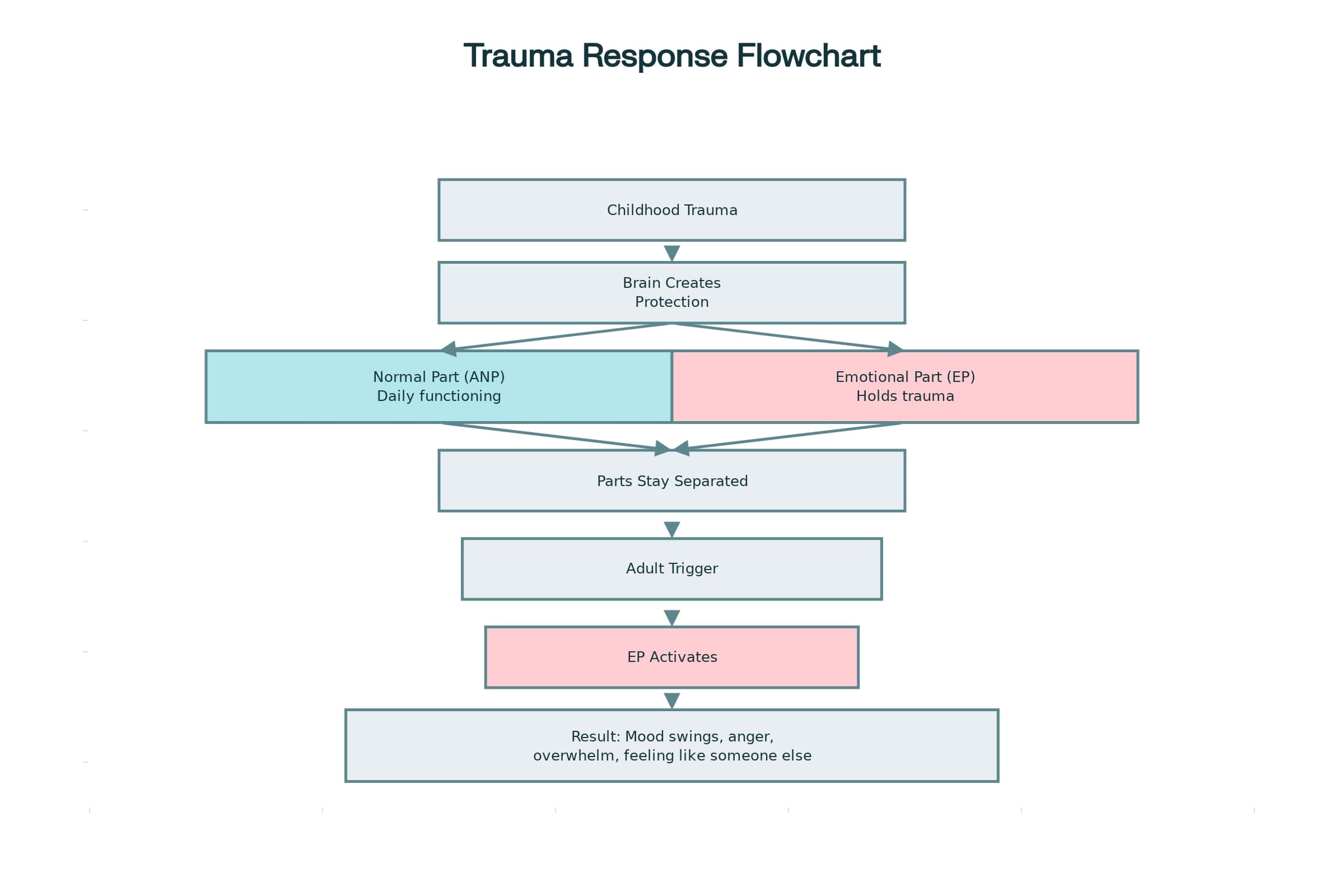
When you experience trauma—especially chronic childhood trauma—your brain can't process it all at once. The experience is too overwhelming. So your mind does something brilliant and terrifying: it splits.
It creates separate "parts" of your personality to handle different aspects of life:
- The "Normal" Part (ANP - Apparently Normal Part): This is the part of you that goes to work, makes dinner, pays bills, and functions in daily life. The ANP avoids trauma. It doesn't "remember" in a felt sense. It keeps you moving forward.
- The "Emotional" Part (EP - Emotional Part): This is the part that holds the trauma—the terror, rage, grief, shame. When the EP gets triggered, it feels like the trauma is happening right now, not in the past.
Here's the key: these parts don't communicate with each other.
Your ANP (the "daily functioning you") tries to avoid anything that reminds you of trauma. But your EP (the "traumatized you") is always there, just under the surface, waiting to be activated by a trigger—a tone of voice, a facial expression, a situation that unconsciously reminds you of the original trauma.
When that trigger happens, the EP takes over. And suddenly, you're no longer the calm, rational adult. You're the terrified child, the enraged teenager, the shut-down survivor.
That's why it feels like "someone else" is in control. Because in that moment, a different part of you is driving.
Relieved to Finally Have a Name for This?
You aren't "crazy"—your brain just did what it had to do to survive. If you're tired of feeling hijacked by your own emotional parts, you need a therapist who specifically understands structural dissociation. Let's talk about how to help your parts feel safe enough to communicate.
Book a 15-Minute Consult (₹400 / $10)What Triggers an Emotional Part (EP)?
Triggers aren't always obvious. You might know that yelling triggers you if you grew up in a home with constant fighting. But many triggers are subtle—what trauma therapists call implicit triggers.
Implicit triggers happen outside your conscious awareness. Your nervous system detects a threat before your thinking brain does. Examples:
- A certain smell that reminds your body (not your mind) of a traumatic event
- A facial expression that matches one you saw during childhood abuse
- A tone of voice—disappointed, irritated, cold—that reactivates old feelings of rejection
- Being ignored in a group conversation (triggering childhood invisibility or emotional neglect)
- Someone walking behind you too closely (triggering hypervigilance even if nothing "bad" happened in the past)
- A romantic partner pulling away slightly (triggering abandonment terror from early attachment wounds)
When these triggers activate an EP, you might:
- Feel a sudden surge of rage that feels out of proportion
- Experience overwhelming sadness or despair that came "out of nowhere"
- Shut down emotionally—feeling numb, detached, or robotic
- Become hypervigilant—scanning for danger, unable to relax
- Feel very young—small, helpless, childlike
- Say or do things you later regret and can't explain
The critical thing to understand: these responses aren't happening because you're "too sensitive" or "can't handle normal stress." They're happening because a part of you is still stuck in survival mode from an unprocessed trauma.
The Difference Between ANP and EP: Why You Feel Like Two People
Let's dig deeper into the two core parts:
The ANP (Apparently Normal Part)
Your ANP is the "adult you"—the one that:
- Manages daily life (work, errands, responsibilities)
- Uses logic and problem-solving
- Tries to avoid thinking about trauma ("That was the past, I'm fine now")
- Minimizes pain ("Other people had it worse")
- Focuses on the future rather than processing the past
The ANP's job is survival through avoidance. It keeps you functional by pushing traumatic material out of awareness.
But avoidance doesn't heal trauma. It just keeps it compartmentalized.
The EP (Emotional Part)
Your EP is the "traumatized you"—the one that:
- Holds the terror, rage, shame, and grief from traumatic experiences
- Experiences the trauma as if it's still happening (not as a memory from the past)
- Gets activated by triggers—conscious or unconscious
- Reacts with fight, flight, freeze, or fawn responses
- Often feels much younger than your current age
The EP's job is survival through emotional expression. It carries what the ANP can't handle.
Here's what makes this so confusing: When your EP is activated, your ANP goes offline. You lose access to your adult logic, your coping skills, your perspective. You're not "choosing" to overreact. You're literally in the trauma in that moment, and your thinking brain isn't in charge.
That's why after a meltdown, you often think, "What the hell was that? Why did I react that way? That wasn't like me."
It wasn't like your ANP. It was your EP.
Why Your Brain Does This: The Adaptive Function of Splitting
Structural dissociation isn't a malfunction. It's an adaptation.
When trauma happens—especially during childhood when your brain is still developing—splitting into parts allows you to:
- Continue functioning even while carrying unbearable experiences
- Maintain relationships with caregivers (even abusive ones) because you need them to survive
- Compartmentalize pain so it doesn't overwhelm you 24/7
In other words, dissociation saved you.
But what helped you survive as a child becomes a problem in adulthood. The split that once protected you now causes:
- Sudden emotional reactivity that damages relationships
- Avoidance of intimacy, vulnerability, or situations that might trigger EPs
- Difficulty regulating emotions (because your ANP never learned—it just avoided)
- Feeling "fragmented" or like you don't know who you really are
Healing isn't about getting rid of your parts. It's about integrating them—helping your ANP and EP(s) communicate, so you can be one cohesive self instead of switching between disconnected parts.
Ready to Stop Feeling Fragmented?
Parts work integrated with EMDR helps your fragmented parts communicate and heal. If you're tired of feeling like "someone else" takes over, let's explore whether this approach fits your needs.
Explore EMDR TherapyHow EMDR + Parts Work Helps You Heal
Traditional talk therapy often doesn't reach EPs. Why? Because EPs don't respond to logic. They're preverbal, somatic, and stuck in implicit memory—the kind of memory that lives in your body and nervous system, not your conscious mind.
This is where EMDR (Eye Movement Desensitization and Reprocessing) becomes powerful.
EMDR works by helping your brain reprocess traumatic memories so they're stored as "past events" instead of "current threats." When you combine EMDR with parts work—specifically addressing ANPs and EPs—you're not just processing memories. You're helping your parts communicate.
What EMDR + Parts Work Looks Like
- Identifying your parts: You and your therapist map out your ANP (daily functioning self) and your EP(s) (the parts holding trauma, rage, terror, shame).
- Building communication: Your therapist helps your ANP recognize and validate your EPs—reducing the phobic avoidance that keeps the split in place.
- Reprocessing trauma: Using EMDR's bilateral stimulation (eye movements, tapping, or tones), your therapist helps your EP(s) process the traumatic memories they're carrying—so the trauma loses its emotional charge.
- Integration: As trauma is processed, the rigid barriers between parts soften. Your ANP and EP(s) begin to integrate, allowing you to access both your adult coping skills and your emotions without getting overwhelmed or shutting down.
The goal isn't to erase your parts. It's to reduce the dissociative barriers so you can be one person with access to all your experiences, emotions, and resources.
Real-Life Example: What This Looks Like in Session
Client Example: Priya, 32, Marketing Manager
Priya came to therapy because she kept "snapping" at her partner over small things—forgetting to text back, leaving dishes in the sink. She described feeling like "someone else takes over" during these moments: "I become this furious, mean person, and I hate myself afterward."
In our early sessions, we mapped her parts:
- Her ANP: Competent, high-achieving, avoids conflict, minimizes her needs.
- Her EP (Child Part): Carries terror and rage from childhood emotional neglect. This part was ignored, dismissed, and told she was "too much" whenever she expressed needs.
When Priya's partner seemed distracted or dismissive (even unintentionally), it triggered her EP—the part that experienced chronic emotional abandonment. Her EP would erupt in anger, trying to be seen and heard the only way it knew how.
Her ANP was horrified by these outbursts. It would try to "fix" things by apologizing excessively, suppressing emotions, and avoiding conflict—reinforcing the split.
Using EMDR + parts work, we:
- Helped Priya's ANP recognize and validate her EP (instead of seeing it as "bad" or "broken")
- Processed the childhood memories where her emotional needs were dismissed
- Reprocessed the implicit belief "If I express my needs, I'll be abandoned"
After 12 sessions, Priya reported: "I still get upset sometimes, but it doesn't feel like someone else is in control. I can feel the emotion and respond like an adult. I'm not hijacked anymore."
Signs You Might Benefit From EMDR + Parts Work
Consider this approach if you relate to several of the following:
- You experience sudden, intense emotional shifts that feel "not like you"
- You describe feeling like "someone else takes over" during anger, panic, or shutdown
- You have childhood trauma (abuse, neglect, instability) but "function fine" in daily life
- You avoid thinking about the past and get frustrated when people suggest therapy
- You feel disconnected from your emotions most of the time—until they explode
- You struggle with intimacy or relationships because you either shut down or react intensely
- You've tried talk therapy but it didn't address the "body feelings" or sudden emotional shifts
- You intellectually understand your trauma but still feel stuck in old patterns
- You experience dissociation, feeling "checked out," or memory gaps during stress
What to Expect in Your First EMDR Session
If you're considering EMDR + parts work, here's what typically happens:
Session 1-3: History and Mapping
Your therapist will ask about your trauma history, current symptoms, and the situations where you feel "hijacked" or "not yourself." Together, you'll start identifying your parts (ANP and EP(s)). No reprocessing yet—just understanding.
Session 3-5: Stabilization and Resourcing
Before any trauma processing, your therapist will teach you grounding techniques and help you build "resources"—internal strengths and safe places you can access when material gets intense. This phase ensures you can handle what comes up during EMDR.
Session 5+: Trauma Reprocessing
Using bilateral stimulation (eye movements, tapping, or tones), your therapist will guide you to reprocess specific traumatic memories. For parts work, this often means helping your EP(s) process what they've been carrying while your ANP stays present and supportive.
Ongoing: Integration
As trauma is processed, the rigid split between ANP and EP(s) softens. You'll notice you can feel emotions without being overwhelmed, respond to triggers with more flexibility, and feel more "whole."
About Dr. Antonio D'Costa
I'm an MD Pediatrician and EMDR therapist providing trauma-focused therapy via secure teletherapy across India. My approach integrates EMDR with parts work to help adults heal childhood and complex trauma.
- M.B.B.S. (Goa Medical College)
- M.D. Pediatrics (KEM Hospital, Mumbai)
- Specialized training in EMDR and trauma-focused therapy
For clients with financial constraints: Sliding scale options are available. Please inquire during consultation.
Common Questions About Structural Dissociation
Related Reading
• When Your Mind Feels Like Fact: Understanding Blended Beliefs
• Finding the Wisdom in "Stuck" Feelings and Protector Parts
• Why You Feel Stuck in Therapy (And What Actually Works for Memory Blocks)
This article is for informational purposes only and does not constitute medical or therapeutic advice. Trauma affects people differently. If you're experiencing significant distress, please consult with a qualified mental health professional. EMDR therapy should only be provided by appropriately trained practitioners. Dr. Antonio D'Costa is an MD Pediatrician. EMDR is an evidence-based specialized therapy for processing traumatic experiences and related emotional symptoms.