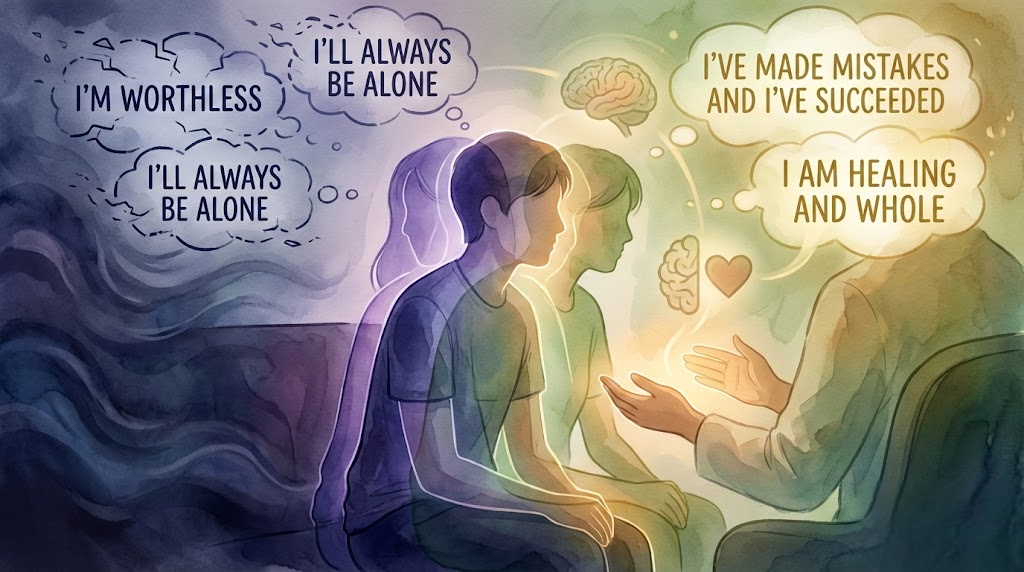
Have you ever been absolutely convinced of something about yourself—"I'm not good enough," "I'll always be alone," "I can't trust anyone"—only to later wonder why you believed it so strongly? Or found yourself making a major decision based on a feeling that seemed like undeniable truth in the moment, only to regret it later?
This experience is more common than you think, and it has a name in trauma therapy: blending. Understanding this concept might be one of the most important insights you gain in your healing journey.
📋 Quick Navigation
What Are "Parts" Anyway?
Before we dive into blending, let's talk about how our minds actually work.
Our psyche isn't one unified voice—it's more like an internal community. Different aspects of ourselves hold different feelings, beliefs, and memories. Some therapists call these "parts," "ego states," or "neural networks." Whatever name we use, the concept is the same: we all have multiple perspectives living inside us.
Think about it: Have you ever felt two ways about something at the same time? Part of you wants to go to that social event, while another part dreads it. Part of you is angry at your partner, while another part loves them deeply. Part of you feels confident at work, while another part fears being exposed as a fraud.
This isn't confusion or instability—it's normal human psychology. We all contain multitudes.
When Parts Carry Painful Beliefs
Some parts of us formed during difficult times and carry painful beliefs from those experiences:
- A part that learned "I'm not lovable" after childhood rejection
- A part that believes "I always fail" after a series of setbacks
- A part that holds "People will hurt me" from past betrayal
- A part convinced "I'm broken" from trauma or chronic illness
- A part that says "I'm too much" after being criticized for expressing needs
These parts developed these beliefs for good reasons—they were trying to make sense of painful experiences and protect us from future harm. The problem? These beliefs were formed in specific contexts, often when we were young or overwhelmed, and they don't represent complete truth about who we are or what our life is.
What Is Blending?
Blending happens when we merge completely with one part's perspective, losing awareness that it's just one viewpoint among many.
When we're blended, that part's belief doesn't feel like "a thought I'm having." It feels like reality. Like fact. Like truth we've finally accepted.
Here's what makes blending so tricky: You don't know you're blended when it's happening. It feels like you've just finally seen things clearly.
A Common Example
Imagine someone who has a part carrying the belief "I'm incompetent." Most of the time, they function well—going to work, managing responsibilities, maintaining relationships. But when they're stressed and make a mistake, they suddenly blend with that incompetent part.
In that moment:
- They can't remember any past successes
- Every small error becomes evidence of complete failure
- They might make impulsive decisions ("I should quit before they fire me")
- If someone reminds them of their accomplishments, they dismiss it ("That was just luck")
- It genuinely feels like they're finally seeing the truth: they ARE incompetent
The person isn't being dramatic or attention-seeking. They're temporarily seeing their entire reality through one part's lens—a part that formed during experiences of shame, criticism, or failure.
How to Recognize When You're Blended
Since blending feels like truth when you're in it, we need concrete ways to check. Here are five tests:
1. The Functionality Test
Question: Am I still functioning despite this belief?
If you believe "I'm completely incompetent" but you're still showing up to work, caring for family, paying bills, and managing life... some parts of you clearly DON'T believe you're incompetent.
When functioning contradicts the belief, you're likely blended with one part, not seeing whole truth.
2. The Body Location Test
Question: Does this belief have a physical location in my body?
When you think "I'm worthless," do you feel it somewhere specific? Heaviness in your chest? Pit in your stomach? Tension in your throat?
If a belief has a body location, it's coming from a part, not from your whole self.
Truth and factual knowledge live in our thinking mind. Emotional beliefs carried by parts live in our body. When you feel a belief somatically, it's a part speaking.
3. The Observer Test
Question: Can I observe this belief, or am I completely merged with it?
There's a difference between:
- "I notice I'm having the thought that I'm unlovable" (observing)
- "I AM unlovable" (merged)
If you can get even 1% distance—noticing "I'm thinking/feeling this"—you're not completely fused. That tiny gap means some part of you is witnessing, which means it's not total truth.
Even asking yourself "Is this really true?" means part of you is questioning, which means you're not 100% blended.
4. The Timeline Test
Question: When did this belief start? Has it always been true, or did it begin at a specific time?
"I'm untrustworthy" might trace back to a specific incident in adolescence. "I'm too sensitive" might have started after being repeatedly told that as a child. "I'll always fail" might connect to a particular series of experiences.
If a belief has a beginning point, it was learned from experience—not inherent truth about who you are.
5. The Internal Conflict Test
Question: Do other parts of me disagree with this belief?
This is perhaps the most important test. Even when one part screams "I'm worthless," ask yourself:
- Is there any part that gets satisfaction from work well done?
- Any part that feels proud of showing up today?
- Any part that cares about people and wants to help?
- Any part that came to therapy seeking change?
If other parts disagree—even quietly—then this isn't consensus truth. It's one part's perspective.
The Internal Democracy Problem
Here's the critical insight that changes everything:
When you're blended with one part, that part is making decisions for your entire internal system—without consulting anyone else.
Imagine if one person in a household decided "This house is terrible, we're moving tomorrow" without asking anyone else's opinion. The kids might love their school. Another adult might have just started a good job. A teenager might have important friendships. But one person's belief—"this house is terrible"—makes a unilateral decision for everyone.
This is what happens internally when we're blended. One part that carries pain says "I can't do this anymore" and tries to make major life decisions—quitting jobs, ending relationships, moving cities, giving up on goals—that affect all the other parts of you.
Why This Matters
When you're blended with a part that believes "I'm not cut out for this career," you might impulsively quit. But you're not consulting:
- The part that worked hard to get this position
- The part that finds meaning in the work
- The part that needs financial stability
- The part that enjoys the colleagues
- The part that's learning and growing
One part's pain doesn't get to override everyone else's needs and wants.
"But What If It Really IS True?"
This is the question almost everyone asks. "What if I'm not blended? What if I'm finally just seeing reality?"
Here's how to think about it:
Partial truth vs. complete truth. The part's belief usually contains partial truth:
- "I've made mistakes" (true) vs. "I'm completely incompetent" (overgeneralization)
- "That relationship ended painfully" (true) vs. "I'll always be alone" (prediction presented as fact)
- "I've been hurt before" (true) vs. "Everyone will hurt me" (absolutism)
The part isn't lying—it's holding one dimension of your experience. But it's not holding all the dimensions.
When you're unblended—connected to your whole self—you can hold complexity:
- "I've made mistakes AND I've also succeeded many times"
- "I've been hurt AND I've also been loved and cared for"
- "Some things are really hard right now AND I have resources and resilience"
Reality is complex. Parts hold simplified, protective beliefs. If it feels absolute, black-and-white, all-or-nothing—check for blending.
What To Do When You Recognize Blending
Step 1: Notice and name it
"I think I might be blended with a part right now."
Step 2: Find it in your body
"Where do I feel this belief? Chest? Stomach? Throat?"
Step 3: Create a little distance
"There's a part of me that believes [this]. I can feel it in my [body location]."
Notice the language shift: from "I AM worthless" to "A part of me feels worthless."
Step 4: Get curious
"How old does this part feel? When did it start believing this? What was it trying to protect me from?"
Step 5: Check with the rest of your internal system
"Do other parts of me agree? What do they think or feel?"
Step 6: Acknowledge without deciding
"This part is in a lot of pain right now. I hear it. But I'm not making any big decisions while blended with it."
The Healing Path
Understanding blending doesn't make it stop happening overnight. These parts have carried their beliefs for years, sometimes decades. They won't let go just because you've learned a new concept.
But this awareness creates a crucial pause—a moment between the part's urgent belief and your response to it.
In that pause, you can:
- Acknowledge the part's pain without acting on its demands
- Consult other parts of yourself
- Wait until you're unblended to make decisions
- Seek support from a therapist who can help you work with these parts
Over time, as you practice recognizing blending and working with your parts, something remarkable happens: The parts begin to trust that you'll listen to them without letting them take over. They don't have to scream so loud or make absolute statements to be heard.
Remember This
You are not broken for having parts with painful beliefs. You're not weak for sometimes being blended with them. This is how human minds work, especially minds that have experienced adversity, trauma, or chronic stress.
The goal isn't to eliminate parts or stop having feelings. The goal is to recognize when one part's perspective is dominating your entire worldview—and to remember that you contain more than that one perspective.
You are larger than any single belief. More complex than any single emotion. More resilient than any single moment of pain.
When a part says "This is who I am," remember to ask: "Is this who *I* am, or is this how one part of me feels right now?"
That question alone can change everything.
Struggling with Blended Beliefs?
EMDR therapy with parts work can help you recognize and work with these beliefs. Book a 15-minute consultation for to discuss how this approach might help you.
Book ConsultationFrequently Asked Questions About Blended Beliefs
Related Reading
• Why Do I Suddenly Become Someone Else? Understanding Your Trauma Response
• When ADHD Feels Like You're Drowning: Why Traditional Therapy Hasn't Worked
• Why You Feel Stuck in Therapy (And What Actually Works for Memory Blocks)
• Between Sessions Homework: Recognizing Thought Patterns and Staying Grounded
This article is for informational purposes only and does not constitute medical or therapeutic advice. Trauma therapy affects people differently. If you're experiencing significant distress, please consult with a qualified mental health professional. EMDR therapy should only be provided by appropriately trained practitioners. Dr. Antonio D'Costa is an MD Pediatrician. EMDR is an evidence-based specialized therapy for processing traumatic experiences and related emotional symptoms.