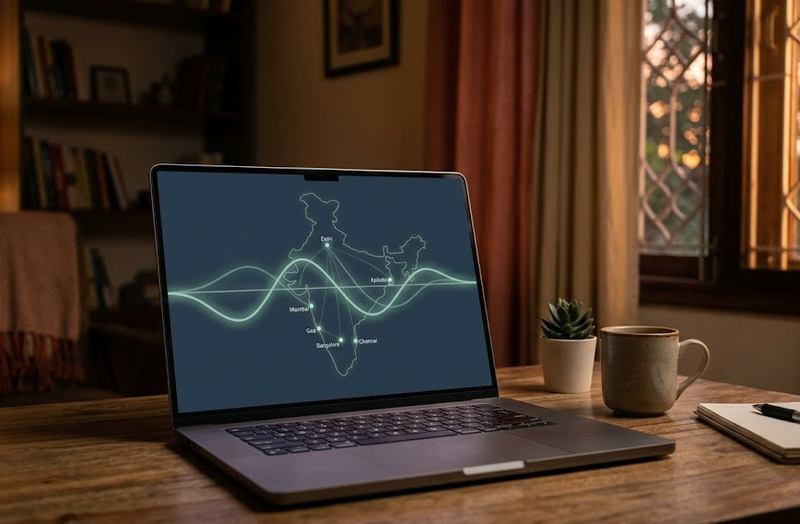
Everything on this page is based on real clinical work with Indian clients — from Delhi to Bangalore, Mumbai to Chennai, and tier-2 cities across the country. If you've been through talk therapy that didn't shift the patterns, this page explains why — and what actually does.
Most therapy in India operates on the same assumption: if you understand your patterns, you'll change them. Talk about your childhood. Identify your cognitive distortions. Develop coping strategies. Do the homework.
For a lot of people, this helps. For many others — especially those carrying complex trauma — it doesn't. You understand exactly why you're anxious. You can explain your people-pleasing in sophisticated psychological terms. You've read the books, followed the accounts, done the worksheets. And you're still stuck.
That's not because you're doing it wrong. It's because insight alone doesn't heal a dysregulated nervous system.
EMDR works differently. It doesn't ask you to think your way out of trauma. It works at the level where trauma actually lives — in the body, in the nervous system, in the stored memories that your brain has never fully processed. This page explains what EMDR is, how online EMDR works across India, who it's for, what it costs, and how to start.
📋 Quick Navigation
Why Talk Therapy Often Fails for Complex Trauma (and What Works Instead)
CBT and supportive counselling have their place. If your primary issue is surface-level — a specific phobia, a recent stressor, a decision you're struggling with — talk therapy can be effective.
But complex trauma is different. Complex trauma — the kind that comes from childhood neglect, emotional abuse, growing up in an unpredictable or unsafe environment, repeated relational wounding over years — doesn't live in your thoughts. It lives in your nervous system. It shows up as a body that won't relax. As hypervigilance you can't turn off. As emotional reactions that are disproportionate to the situation and you can't explain. As a persistent sense that something is wrong with you, even when everything on paper looks fine.
When you try to think your way out of this, you're using the wrong tool.
EMDR is a bottom-up approach. Instead of starting with thoughts and working down, it starts with the body and the stored memory and works up. The mechanism is bilateral stimulation — rhythmic left-right input (eye movements or tapping) that activates your brain's natural memory reprocessing system — the same system that runs during REM sleep. While this processing is active, we work through a target memory. Your brain does what it couldn't do at the time of the trauma: it processes the experience fully, strips the emotional charge, and files it in the past where it belongs.
The full protocol has 8 phases: history-taking, preparation (building grounding resources), assessment, desensitisation (processing), installation (strengthening positive beliefs), body scan, closure, and re-evaluation. It's structured, evidence-based, and recognised by the WHO and NICE guidelines as a first-line treatment for PTSD.
I don't offer generic talk therapy. I offer EMDR. If EMDR isn't the right modality for you, I'll tell you honestly during the consultation and point you toward what might work better.
Online EMDR Therapy — Accessible from Anywhere in India
You don't need to travel to Goa. Every session happens via secure video call. Same method. Same results. No train tickets, no traffic, no explaining to anyone why you're seeing a therapist.
What You Need
- A private room where you won't be interrupted for 60–90 minutes.
- Stable internet — standard broadband or 4G/5G is sufficient.
- A laptop or tablet with a webcam. Phone screens are too small for effective bilateral stimulation.
- Headphones for privacy and audio clarity.
I use a secure, encrypted video platform designed for healthcare — not a consumer app. You'll receive a link before each session. No software to install.
What Happens in a Session
First consultation (15 or 30 minutes): You tell me what's going on. I explain EMDR and demonstrate bilateral stimulation on screen. I answer every question. We decide together whether to proceed.
First full session (60–90 minutes): We build the foundation. History-taking (efficient, not exhaustive). Grounding resources — you learn techniques to regulate your nervous system before we touch anything difficult. I'll demonstrate bilateral stimulation and you'll experience it in a neutral, safe context.
Processing sessions: Once preparation is solid, we begin working through target memories using bilateral stimulation. The session includes a check-in, processing work, and a proper closing sequence so you leave grounded and functional. Between sessions, your brain continues integrating — which is why we typically space processing sessions at least a week apart.
Ready to Start?
Book a 15-minute video consultation for just ₹400. No obligation, no pressure — just a conversation to see if EMDR is right for you.
Book Your Consultation — ₹400Who Is EMDR For? (You Might Resonate With These)
Based on the clients I actually see, here are the patterns that bring people to EMDR.
Young professionals (20–35) who've been told they have anxiety or depression, have tried CBT or counselling, and feel like they're "going in circles." They know why they're anxious. It hasn't stopped. Many have CPTSD that was misdiagnosed as generalised anxiety disorder or major depression — a pattern I see constantly in India, where trauma-informed assessment is still rare outside specialist settings.
High-functioning adults who perform well externally — good jobs, relationships, social lives — and feel hollow internally. They describe themselves as "numb," "disconnected," or "performing." The perfectionism that drives their success is also what's exhausting them. The people-pleasing that makes them likeable is also what's eroding their sense of self. They've read every book. They can't think their way out of this.
Adults with childhood trauma histories — emotional neglect, harsh or critical parenting, domestic violence in the home, bullying, or the quieter forms of developmental trauma that don't register as "trauma" in the Indian social context but shaped the nervous system all the same. Often these clients didn't realise their childhood was traumatic until they started connecting the dots between their current symptoms and their early environment.
Neurodivergent adults — ADHD, autism, AuDHD — who've been told their entire lives that they're "lazy," "too sensitive," or "not trying hard enough." Many have internalised shame that compounds the trauma. EMDR works differently from talk therapy: it doesn't require you to explain, narrate, or analyse the way traditional approaches do. It works directly with the nervous system that's been on high alert for decades.
Common presenting issues: overthinking, emotional numbness, hypervigilance, intrusive thoughts, people-pleasing, perfectionism, self-sabotage, relationship patterns that keep repeating, a persistent feeling of being "not enough," and physical symptoms (headaches, gut issues, chronic fatigue) that no medical test can fully explain.
A client from Delhi — 28, software engineer — had done three years of CBT. He could explain his anxiety in clinical detail. His therapist told him he was "highly insightful." But every Sunday evening, the dread hit: chest tightness, racing thoughts, the certainty that something terrible was about to happen. He couldn't name what. Eight EMDR sessions later, the Sunday dread had stopped. His nervous system had finally gotten the message that he was safe. He didn't need to understand it better. He needed his body to know it.
EMDR Therapy Cost in India — Transparent Pricing
Most therapy in India ranges from ₹1,000–2,500 per session for general counselling or CBT. Specialist trauma therapy — particularly EMDR with a medical professional — sits at the higher end of this range.
Here's exactly what I charge. No hidden costs. No long-term packages pushed.
| Session Type | Duration | Cost (INR) |
|---|---|---|
| Initial Consultation | 15 minutes | ₹400 |
| Extended Consultation | 30 minutes | ₹600 |
| Standard EMDR Session | 60 minutes | ₹3,000 |
| Extended EMDR Session | 90 minutes | ₹4,000 |
| Reduced Fee EMDR | 60 minutes | ₹2,500 |
What's included in each session: full 60 or 90 minutes of clinical time, resourcing and grounding work, bilateral stimulation processing, proper session closure, and integration guidance between sessions. You're not paying for a clock on the wall — you're paying for a complete therapeutic process.
Payment: INR via Razorpay — UPI (Google Pay, PhonePe, Paytm), all credit/debit cards, and net banking. Invoice after each session. No minimum commitment. You pay per session. If you need to stop, you stop.
A 12-session course of EMDR costs ₹30,000–48,000. Compare this to the cost of staying stuck — the promotions lost to self-sabotage, the relationships damaged by unprocessed patterns, the years spent managing symptoms that don't resolve. EMDR isn't cheap. It's also not a recurring expense. Most clients complete treatment and move on. It's designed to be finite.
Where in India Are Clients From?
I've worked with clients across the country. The geography doesn't matter — the method works through a screen. Here's where people have joined from:
Delhi NCR: Delhi, Gurgaon, Noida, Ghaziabad — the largest single group of clients. The concentration of high-pressure jobs and the relative scarcity of trauma-informed therapists in the capital create consistent demand.
Bangalore: Tech professionals, startup founders, and young adults who've relocated from hometowns. High insight, high intellectual capacity — often stuck despite years of self-analysis.
Mumbai, Navi Mumbai, Pune: A mix of corporate professionals and students. The financial capital's work culture creates specific patterns of burnout and self-sabotage.
Chennai and Hyderabad: Clients from both metro and surrounding areas. Strong professional drive paired with traditional family dynamics that can be a source of both support and complex relational trauma.
Chandigarh, Mohali, Ambala: Growing demand from the northern belt outside Delhi. Good awareness of mental health but limited access to specialist trauma treatment.
Kolkata: Fewer in number but consistent.
Goa: Local clients access therapy online, like everyone else across India.
Tier-2 cities: Haldwani, Rourkela, Vijayawada, Indore, Bhilai, Kurukshetra, and others. These are the places where specialist trauma therapy is genuinely hard to find. Online EMDR fills a gap that local infrastructure can't.
Wherever you are in India, as long as you have internet, you can access EMDR therapy. The same protocol, the same clinician, the same results — whether you're in a high-rise in Gurgaon or a family home in Haldwani.
Client Experiences (De-Identified)
Everything below is based on real patterns from real clients. Names, identifying details, and specific contexts have been altered or composited.
Client A — 25, Delhi. Three years of CBT with limited progress. Found EMDR via Reddit. Eight sessions focused on childhood emotional neglect and bullying. Outcome: significant reduction in baseline anxiety. Stopped having panic attacks before work meetings for the first time in years. Reported improved relationships with colleagues and friends.
Client B — 32, Bangalore. CPTSD from developmental trauma. Self-sabotage at work — would freeze or procrastinate on high-stakes projects despite being capable. Had tried multiple therapists over five years. Ten-plus sessions with ongoing processing. The self-sabotage pattern has loosened substantially. Still in treatment, working through deeper targets.
Client C — 22, Chennai. Childhood trauma and emotional numbness. Reduced-fee slot. Seven sessions. Outcome: "I can finally feel my emotions without shutting down." Reconnected with creative interests that had been dormant for years.
Client D — 29, Mumbai. High-performing finance professional. Perfectionism and impostor syndrome that didn't budge with coaching or self-help. Six sessions targeting early experiences of conditional approval from parents. Outcome: noticeable reduction in the internal critic. Able to make decisions without hours of agonising.
These are not miracles. They're not "and then everything was perfect." They're what real trauma processing looks like: steady, measurable shifts in patterns that had been stuck for years — sometimes decades.
How to Start — Your First Step
The process is simple and pressure-free.
Step 1: Book a 15 or 30-minute video consultation. Use my online scheduling system — it shows real-time availability in IST. 15 minutes costs ₹400. 30 minutes costs ₹600. No obligation to continue.
Step 2: We meet on video. You tell me what's happening — in as much or as little detail as you're comfortable with. I explain how EMDR works. I demonstrate bilateral stimulation on screen. I answer every question you have. This is a conversation, not an intake interview.
Step 3: Decide together. If EMDR feels right, we schedule your first full session. If it doesn't, that's fine. You leave with a clearer understanding of your options. Nothing to prepare beforehand. Just show up.
You've Tried Understanding the Patterns. Now Resolve Them.
Book a 15-minute consultation for ₹400. No commute. No waiting room. No obligation beyond the conversation.
Book Your Consultation — ₹400Frequently Asked Questions
Related Reading
• EMDR Therapy Cost in India: Complete Pricing Guide
• The Complete Guide to EMDR Therapy: All 8 Phases
• Can EMDR Therapy Be Done Online? What You Need to Know
• The Chameleon Disorder: Why CPTSD Gets Misdiagnosed for Decades
• EMDR for Anxiety: Does It Work?
• Why Your Therapist Isn't Helping (And What Actually Works for Trauma)
• EMDR for Autism, ADHD & Alexithymia
This article is for informational purposes only and does not constitute medical or therapeutic advice. EMDR therapy should only be provided by appropriately trained practitioners. Dr. Antonio D'Costa is an MD Pediatrician (Goa Medical Council Registration: 3764) and EMDR therapist with EMDRIA-approved training. If you are in crisis, contact Kiran (1800-599-0019, 24/7 mental health helpline), iCall (9152987821), or visit your nearest hospital emergency department.