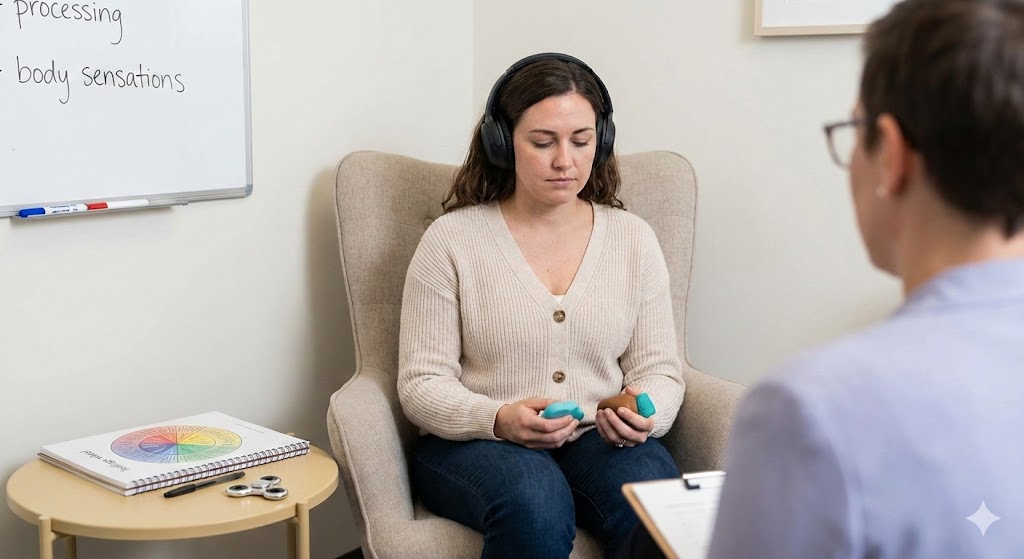
Have you ever finished a therapy session and genuinely couldn't answer whether it helped? Your therapist asks "How intense is that memory now?" and you're stuck. Maybe you give a random number, or say "I don't know." You leave wondering if therapy is actually working, or if you're wasting time and money on something that isn't helping.
If you've noticed this pattern—especially if you're autistic, have ADHD, or carry complex trauma—there's something important to understand about how your nervous system processes emotional information. The challenge might not be that therapy isn't working. It might be how progress is being measured.
As an MD Pediatrician and EMDR Therapist, I work with clients who struggle with exactly this: they come back to sessions unable to report subjective emotional shifts, yet their lives are changing in measurable ways. Their sleep improves. They return to activities they'd avoided. Their families notice they're less reactive. But they can't feel the difference the way therapy textbooks say they should.
This is where understanding alexithymia and interoceptive awareness becomes clinically essential—not as labels to apply to you, but as a framework for adapting how therapy actually works.
📋 Quick Navigation
- What Happens When You Can't Sense Emotional Changes
- Research: Alexithymia and Interoceptive Awareness
- How Standard EMDR Progress Tracking Breaks Down
- How I Adapt EMDR When Interoceptive Awareness Is Reduced
- Evidence: Does EMDR Actually Work With These Challenges?
- What You Can Do: Building Interoceptive Awareness
- Frequently Asked Questions
What Happens When You Can't Sense Emotional Changes
Let me start with what these terms actually mean, because the language matters.
Alexithymia describes difficulty identifying and naming emotions—any emotions, not just negative ones. It's not an inability to have feelings. It's a difficulty with the middle step: recognizing what feeling is present, then finding words for it.
Interoceptive awareness is simpler: it's your ability to sense what's happening inside your body in the moment. Heart rate, breath, muscle tension, stomach sensations, that vague sense that "something feels off"—these are interoceptive signals. Your brain's anterior insula region processes this information.
Here's the clinical connection: when someone can't sense their internal body states clearly, they also struggle to recognize and name emotions. It's not separate—they're connected. And when both are diminished, standard therapy progress metrics fall apart.
Why This Matters for EMDR and Trauma Therapy
Traditional EMDR asks questions like: "Rate your distress 0-10" or "Where do you feel this in your body?". The therapist tracks whether that number goes down, whether sensations change, whether emotional intensity shifts.
But if someone genuinely cannot tell if something feels "intense" or not, these questions become impossible to answer honestly. Not because they're resisting. Not because therapy isn't working. Because the feedback system they're being asked to use isn't accessible to them.
One person described this experience: "I'm damn near certain it's an issue I need to work through in therapy and not merely a chemical imbalance. But nope, can't do that. Too busy dissociating when I try to activate my emotional side and looking like I'm fine the whole time. I am in agony."
This is the core problem: when your internal feedback system doesn't work the way therapy assumes it should, you can't provide the data therapists are looking for. And without that data, neither you nor your therapist can accurately track progress.
Research: Alexithymia and Interoceptive Awareness in Autism, ADHD, and Trauma
Autism
Research shows that in autistic individuals, alexithymia and reduced interoceptive awareness often co-occur. Studies found that higher levels of alexithymia correlate with lower interoceptive sensation during emotional experiences. The brain connections between the insula (the body-sensing region) and the prefrontal cortex (the thinking region) show different patterns in autism, which may explain why identifying and naming feelings is so difficult.
One significant finding: many traits previously attributed to autism itself—like reduced empathy or social-emotional difficulties—may actually relate more to co-occurring alexithymia than to autism per se.
ADHD
The ADHD research is mixed. Some studies show intact interoceptive accuracy in adults with ADHD, but emerging research suggests ADHD symptoms correlate with lower interoceptive awareness in daily functioning. This distinction matters: you might be able to accurately report physical sensations in a lab setting, but struggle to notice and use interoceptive signals in real life—which is where it actually impacts decision-making and emotional regulation.
One study found that interoceptive awareness mediated the relationship between ADHD and intuitive eating. In other words, the reduced ability to notice internal signals (hunger, fullness, emotional states) is a key mechanism linking ADHD symptoms to real-world challenges.
Complex Trauma and Dissociation
Trauma creates disconnection from the body as a protective mechanism. Dissociation—that sense of being outside yourself or disconnected from what's happening—keeps overwhelming sensations and emotions from flooding your system during trauma. When trauma stays unprocessed, this dissociative response persists, and the disconnection from body signals and internal states remains.
Complex trauma often creates what researchers call "structural dissociation," where different "parts" of your internal experience hold separate emotions, memories, and perspectives. This fragmentation makes it extremely difficult to have a coherent sense of how you feel in the present moment.
How Standard EMDR Progress Tracking Breaks Down
Let me show you concretely where the disconnect happens.
A typical EMDR session involves:
- Identifying a traumatic memory or distressing thought
- Rating its intensity (SUDS scale: 0-10)
- Processing with bilateral stimulation
- Checking how the rating has changed
The assumption is: you can sense whether something feels more or less intense, and you can report that change accurately.
But what if:
- You genuinely cannot tell if something feels "intense" or not?
- You can't sense the difference between intensity levels?
- You report a number, but it's basically a guess?
- Your therapist thinks progress isn't happening, when in reality it is—just not in ways the standard metrics capture?
This creates a real clinical problem. Your therapist lacks accurate data. You lack confirmation that therapy is working. Everyone feels stuck.
Does This Resonate With Your Experience?
Book a consultation to discuss whether standard therapy metrics fit your neurology.
Book a ConsultationHow I Adapt EMDR When Interoceptive Awareness Is Reduced
In my practice, I work with this limitation directly. Rather than abandoning EMDR, I modify it:
Objective Progress Markers Replace Subjective Ratings
Instead of relying primarily on subjective distress reports, I track:
- Behavioral patterns: Changes in sleep, appetite, social engagement, frequency and intensity of emotional dysregulation
- Cognitive shifts: Different thoughts about the memory or trigger, even if you can't report emotional changes
- External observation: What partners, family, or close people notice changing
- Physiological markers: Heart rate patterns, breathing changes, observable tension
- Body-mapping: Drawing where you notice sensations, even if the sensation itself is unclear
Extended Resourcing and Preparation
Before processing trauma, I invest more time building internal resources:
- Interoceptive vocabulary: Creating your personalized map of what different emotional/body states feel like (even if subtle)
- Body scan practice: Regular exercises to gradually strengthen brain-body connection
- Grounding techniques: Concrete, reliable anchors for when dissociation occurs
- Parts mapping: Identifying and understanding different internal experiences in complex trauma
Modified Processing Pace and Frequency
With reduced interoceptive awareness:
- I use shorter sets of bilateral stimulation
- I check in more frequently with specific, concrete questions rather than general emotional intensity questions
- Processing unfolds across more sessions rather than pushing through quickly
- I explicitly validate that "I don't know" is genuine, useful clinical information
Evidence: Does EMDR Actually Work With These Challenges?
Research on EMDR for autism shows that people may require more sessions and modified protocols than standard EMDR, but can still achieve significant symptom reduction. One study specifically found that EMDR targeting everyday stress in autistic adolescents improved stress levels and overall functioning, even when core autism traits showed only partial changes.
The adaptation is what makes the difference, not abandoning the method.
What You Can Do: Building Interoceptive Awareness
If you're recognizing yourself in this description, here are practical steps:
Start Small With Body Awareness
- Daily pause practice: Set 3 phone alarms daily. When they go off, pause for 30 seconds and notice 3 body sensations—no judgment about what they are
- Emotion-sensation chart: Keep a simple chart linking situations with any body sensations you notice, even vague ones
- Brief mindfulness: 2-3 minutes daily of just observing your breath or body sensations
- Gentle movement: Yin yoga, slow stretching, or somatic shaking practices can help reconnect to body signals over time
Track Objective Life Changes
Keep a simple weekly log:
- Sleep hours and nightmare frequency
- Energy level (1-10 scale)
- Social interactions (how many, quality)
- Meltdowns or emotional dysregulation (frequency, duration)
- Activities you did or attempted
These external markers often show progress before subjective emotional awareness catches up.
Have Clear Conversations With Your Therapist
If you work with a therapist, be explicit: "I struggle to identify what I'm feeling. I'll say 'I don't know' a lot because I genuinely cannot tell. Here's what I can track instead: sleep, energy, whether I'm avoiding things." A skilled trauma therapist should adapt their approach.
Give the Process Time
EMDR research shows most single-trauma work needs 6-12 sessions. Complex trauma typically requires 12-20+ sessions. Add more time if interoceptive awareness is reduced—not because you're "harder to treat," but because the measurement and processing pace need adjustment.
Frequently Asked Questions
Ready to Start Adapted EMDR Therapy?
Book a consultation to discuss your unique challenges with emotional awareness and how we can adapt EMDR to work for your nervous system.
Book Your AppointmentRelated Reading
• EMDR for ADHD Emotional Dysregulation: India Guide
• Why Do I Suddenly Become Someone Else? Understanding Trauma Parts
• The Complete Guide to EMDR Therapy: All 8 Phases Explained
This article is for informational purposes only and does not constitute medical or therapeutic advice. Trauma affects people differently. If you're experiencing trauma symptoms, please consult with a qualified mental health professional. EMDR therapy should only be provided by appropriately trained practitioners. Dr. Antonio D'Costa is an MD Pediatrician. EMDR is an evidence-based specialized therapy for processing traumatic experiences and related emotional symptoms.