Everything in this article is based on real clinical work with Canadian clients — from downtown Toronto to Vancouver Island to Edmonton. The barriers to trauma therapy in Canada are real. So are the workarounds.
A client from Edmonton reached out last winter after spending three months on a waitlist for a trauma therapist who took her benefits plan. She'd been through workplace trauma that left her unable to step into an office without panic symptoms. By the time a spot opened, she'd already been doing EMDR with me for six weeks — and she was sleeping through the night again.
She's one of many Canadians I've worked with. The pattern is consistent: motivated people stuck in a system that can't move fast enough.
If you're searching for EMDR therapy in Canada — whether you're in Toronto, Vancouver, Montreal, Calgary, Edmonton, Ottawa, Winnipeg, Halifax, or anywhere in between — you've probably noticed that access is uneven, waitlists are common, and the whole thing can feel like another source of stress rather than relief.
This article explains the alternative: online EMDR with a qualified trauma therapist, at a clear USD rate, no waiting list — and how the time zones actually work.
📋 Quick Navigation
EMDR Therapy in Canada: What's Available?
Let's be clear about the landscape.
EMDR is well-established in Canada. It's recognised by the Canadian Psychological Association and widely used for PTSD treatment. But recognition and access are two different things.
If you're looking for a trauma therapist in a major city — Toronto, Vancouver, Montreal, Calgary — you'll find options. But wait times of 2–6 weeks are common for experienced EMDR practitioners, and the most sought-after therapists often have closed waitlists. If you're in a smaller city like Winnipeg, Halifax, or anywhere in the territories or rural Canada, the options thin out dramatically.
There's also the funding reality. Provincial health plans (OHIP, MSP, RAMQ, etc.) generally don't cover private psychotherapy. If you have workplace benefits, you may be covered for a registered psychologist or social worker — but coverage caps are common, and 12–20 sessions of complex trauma treatment can quickly exhaust a year's allowance. Without benefits, you're paying out of pocket entirely.
This isn't a criticism of Canadian therapists. The people doing this work are skilled and committed. But the infrastructure hasn't kept pace with demand — especially post-pandemic, especially for complex trauma.
Online EMDR doesn't fix the funding question. But it removes the geography barrier, the waitlist, and a significant portion of the cost.
How Online EMDR Actually Works for Canadians
The research is consistent. McGowan et al. (2021) in BMC Psychiatry found online EMDR as effective as in-person for reducing PTSD symptoms. A 2023 systematic review in Frontiers in Psychiatry — covering 16 studies and over 1,200 participants — concluded remote EMDR is a feasible, effective alternative. A 2024 Cardiff University service evaluation comparing online to in-person EMDR across 78 patients found no difference in outcomes, completion rates, or safety.
I've seen this work firsthand with Canadian clients from three time zones. The method translates across the screen without losing anything essential.
How a Session Works Over Video
EMDR's core is bilateral stimulation — rhythmic left-right input (visual or tactile) that activates your brain's natural memory reprocessing system while we work through a target memory or theme. The same 8-phase protocol applies whether I'm in Goa and you're in Ottawa.
On screen, I guide you through:
- Visual bilateral stimulation: I share my screen and you follow a moving dot or bar with your eyes. Your camera lets me track your eye movements and adjust speed in real time.
- Tactile bilateral stimulation: I guide you through alternating butterfly taps on your chest or arms. For clients with complex trauma or higher dissociation, this is often more grounding than eye movements.
What you need: a stable internet connection (standard home broadband), a laptop or tablet with a webcam (phones are too small for processing), headphones for privacy, and a quiet private room for 60–90 minutes.
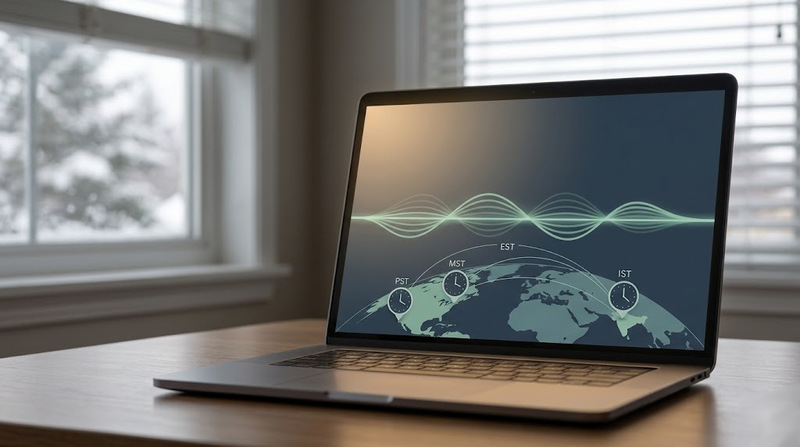
The Time Zone Reality: IST ↔ Canada (Honest Mapping)
Here's the practical truth. Unlike the UK and Australia (where evening sessions map neatly to my afternoon), Canadian sessions happen in your morning/early afternoon and my evening.
Canada is behind India by 9.5 to 13.5 hours depending on where you are. I offer sessions up to 9:30 PM IST. Here's what that means for you:
| Your Timezone | Cities | Your Session Window (Local) | My Time (IST) |
|---|---|---|---|
| EST (UTC-5) | Toronto, Montreal, Ottawa | 7:00 AM – 11:00 AM | 5:30 PM – 9:30 PM |
| CST (UTC-6) | Winnipeg | 7:00 AM – 9:00 AM | 6:30 PM – 8:30 PM |
| MST (UTC-7) | Calgary, Edmonton | 7:00 AM – 9:00 AM | 7:30 PM – 9:30 PM |
| PST (UTC-8) | Vancouver | 6:00 AM – 8:00 AM | 7:30 PM – 9:30 PM |
| AST (UTC-4) | Halifax | 7:00 AM – 12:00 PM | 4:30 PM – 9:30 PM |
For Toronto, Montreal, or Ottawa clients: a 9 AM session is 7:30 PM for me. Perfectly workable — finish your morning coffee, do a session, start your workday. For Vancouver: sessions happen early (6–8 AM), which some clients actually prefer as a quiet start before the day begins. For Halifax: the widest window — you have the most flexibility.
My scheduling system automatically shows availability in your local timezone. No mental math required.
Session Types and Investment
Transparency first. Here's exactly what sessions cost.
First Session: Assessment and Resourcing (60–90 minutes)
Your first full session is longer because we don't rush into trauma processing. We cover your history (not exhaustively — enough to work safely), build grounding resources, and I'll demonstrate bilateral stimulation on screen so you know exactly what to expect before we do any real work.
$50 (60 mins) or $75 (90 mins).
Regular Processing Sessions (60 or 90 minutes)
Each processing session includes a brief check-in, bilateral stimulation work on a target memory or theme, and proper closing to leave you grounded. Some clients prefer 60 minutes ($50); those with complex trauma often find 90 minutes ($75) gives the nervous system room to fully process.
Pricing at a Glance
| Session Type | Duration | Cost (USD) |
|---|---|---|
| Initial Consultation | 15 minutes | $12 |
| Extended Consultation | 30 minutes | $20 |
| Standard EMDR Session | 60 minutes | $50 |
| Extended EMDR Session | 90 minutes | $75 |
Payment methods: Credit/debit card via secure payment gateway, bank transfer, or PayPal. All transactions in USD. Invoice provided after each session.
Ready to Start?
Your first 15-minute video consultation costs $12. No obligation, no pressure — just an honest conversation about whether this approach fits your situation.
Book a 15-Minute Consultation – $12Is Online EMDR Right for You?
Online EMDR works well for many people. It's not right for everyone.
You're likely a good fit if:
- You've tried talk therapy — maybe through an EAP, a private psychologist, or a counsellor — and still feel stuck in the same patterns: hypervigilance, numbing, intrusive memories, emotional flooding.
- You carry complex trauma: childhood neglect or abuse, long-term relational trauma, developmental trauma. The kind that doesn't resolve with six sessions of CBT.
- You're neurodivergent (ADHD, autism, AuDHD) and talk therapy hasn't worked with your brain. EMDR doesn't require you to narrate or explain — it works at the nervous-system level.
- You're a morning person — or at least willing to do a session before your workday starts. For most Canadian time zones, the sweet spot is 7–10 AM local.
- You live outside a major city or in a region where trauma-trained therapists are scarce. This applies to huge swaths of Canada.
- You have a private, quiet space and a stable internet connection.
Online EMDR is not appropriate if:
- You are in acute crisis — actively suicidal, unable to keep yourself safe. You need in-person crisis support. Call 988 (Suicide Crisis Helpline), visit your nearest emergency department, or contact your local crisis centre.
- You have active psychosis that is not well-managed. EMDR may be possible with psychiatric coordination, but it requires stabilisation.
- You have severe dissociation without prior stabilisation work. Dissociation isn't a blanket contraindication — but online work needs a baseline level of grounding we'd assess first.
- You cannot do early morning sessions. For Vancouver clients especially, the window is tight (6–8 AM). If that doesn't work for you, this might not be the right fit.
If you're unsure, the consultation is exactly for this. We talk through your situation honestly. If I don't think online EMDR is right for you, I'll tell you directly.
Getting Started
The process is simple and pressure-free.
Step 1: Book a 15-minute video consultation ($12). My scheduling system shows real-time availability in your local Canadian timezone — no converting, no confusion.
Step 2: We meet on video. You tell me what's happening — in as much or as little detail as you're comfortable with. I explain EMDR, demonstrate it on screen, and answer every question you have.
Step 3: If you want to continue, we schedule your first full session. If you don't, no obligation. The consultation is a standalone conversation.
Start This Week — No Waiting List
View my real-time availability and book a 15-minute consultation. It's $12, completely confidential, and there's no obligation to continue.
Book a 15-Minute Consultation – $12Frequently Asked Questions
Related Reading
• Can EMDR Therapy Be Done Online? What You Need to Know
• EMDR Therapy Cost: Complete Pricing Guide
• The Chameleon Disorder: Why CPTSD Gets Misdiagnosed for Decades
• EMDR for Anxiety: Does It Work?
• EMDR for Autism, ADHD & Alexithymia
• EMDR Therapy in the UK: Online Treatment Without the NHS Wait
This article is for informational purposes only and does not constitute medical or therapeutic advice. EMDR therapy should only be provided by appropriately trained practitioners. Dr. Antonio D'Costa is an MD Pediatrician and EMDR therapist with EMDRIA-approved training. If you are in crisis, please call 988 (Suicide Crisis Helpline), visit your nearest emergency department, or contact your local crisis centre.