Everything in this article is based on real clinical work with Australian clients. I've been treating people across Sydney, Melbourne, Brisbane, Perth, and regional Australia via video call. The access problem for trauma therapy here is real — and there's a practical solution.
A client from Newcastle — two hours north of Sydney — contacted me last year after spending weeks calling every EMDR therapist within driving distance. The ones in Sydney had waiting lists. The one in Newcastle was booked solid. She'd been carrying complex trauma from a childhood in foster care and she was exhausted from the search itself, let alone the symptoms.
She's not alone. I hear versions of this from Australian clients regularly.
If you're searching for EMDR therapy in Australia — whether you're in Sydney, Melbourne, Brisbane, Perth, Adelaide, the Gold Coast, Canberra, or anywhere regional — you may have already discovered that access is patchy, wait times are real, and the whole process can feel like another burden on top of what you're already carrying.
This article is about the alternative that works: online EMDR with a qualified trauma therapist, at a straightforward USD rate, with no waiting list.
📋 Quick Navigation
Finding an EMDR Therapist in Australia: The Reality
Let's talk about what actually happens when you try to access EMDR in Australia right now.
EMDR is recognised as a first-line treatment for PTSD by the Australian Psychological Society. It's widely recommended. But availability hasn't kept up with demand.
In major cities, expect a 2–4 week wait for a private EMDR therapist. That's if you can find one accepting new clients — many are full. A quick search across therapist directories shows Sydney and Melbourne have the highest concentration of EMDR practitioners, but even there, experienced trauma therapists often run waitlists. Brisbane, Perth, and Adelaide have fewer options. Canberra is extremely limited.
Outside the capital cities, the situation is worse. If you live in regional NSW, rural Queensland, the Northern Territory, or anywhere remote, you may have zero EMDR-trained therapists within a reasonable distance. Several Australian telehealth EMDR services now exist specifically because of this gap — therapists know the geography is a barrier.
This isn't a criticism of Australian mental health services. The Medicare Better Access initiative has helped, and the EMDR Association of Australia continues to train practitioners. But the gap between what's recommended and what's accessible is wide — especially if your trauma is complex and you need someone who won't rush you through six sessions of manualised treatment.
There's also the cost factor. Private psychology sessions in Australia typically run well above what many people can sustain for the 12–20 sessions that complex trauma often requires.
Online EMDR changes the geography equation entirely. And it does it without compromising the method.
Online EMDR: Same Method, Your Space
The short answer: yes, online EMDR works.
McGowan et al. (2021), published in BMC Psychiatry, evaluated EMDR delivered via the internet and found statistically significant reductions in PTSD symptoms across 93 patients — comparable to in-person outcomes. A 2023 systematic review in Frontiers in Psychiatry examined 16 studies of remote EMDR involving over 1,200 participants and concluded that online delivery is feasible and potentially effective as an alternative to in-person trauma therapy. A 2024 Cardiff University service evaluation comparing online to in-person EMDR across 78 patients found no evidence of a difference in therapy completion, drop-out rates, or adverse events.
I've treated Australian clients from inner-city Melbourne apartments to remote Queensland properties. The method holds. The screen doesn't get in the way.
How It Works Over Video
EMDR's core mechanism is bilateral stimulation — rhythmic left-right input that helps your brain reprocess stuck traumatic memories. The same 8-phase protocol applies whether we're in the same room or on opposite sides of the Indian Ocean.
Over video, I guide you through:
- Visual bilateral stimulation: I share my screen and you follow a moving dot or bar with your eyes. Your camera lets me monitor your eye movements so I can adjust speed and track your response throughout.
- Tactile bilateral stimulation: I guide you in self-administered butterfly tapping — alternating taps on your chest or upper arms. For many clients, especially those with complex trauma and higher dissociation, this is actually more grounding than eye movements.
What you need: a stable internet connection (standard NBN or home broadband is fine), a laptop or tablet with a webcam, headphones for clarity and privacy, and a quiet room where you won't be interrupted for 60–90 minutes.
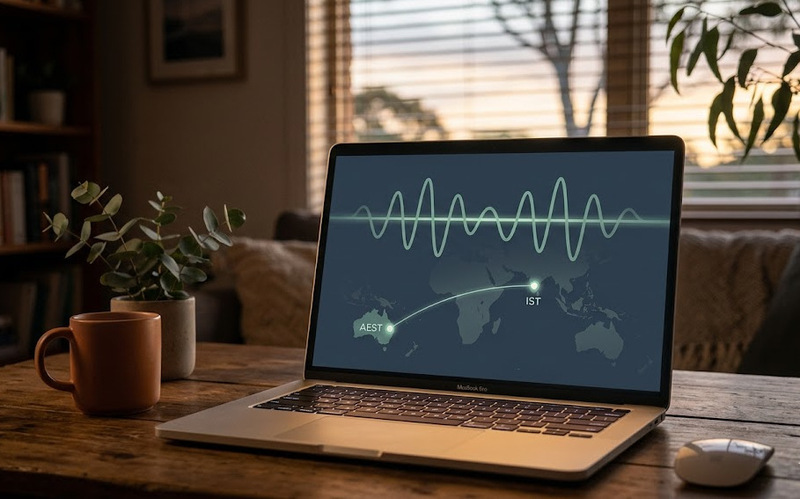
The Time Zone Advantage: IST ↔ AEST/AEDT/AWST
Here's something that works surprisingly well for Australian clients.
I'm in Goa, India (IST, UTC+5:30). Australia spans multiple time zones:
- AEST (Sydney, Melbourne, Brisbane, Canberra, Gold Coast, Newcastle): UTC+10 — 4.5 hours ahead of IST
- AEDT (summer daylight saving): UTC+11 — 5.5 hours ahead of IST
- AWST (Perth): UTC+8 — 2.5 hours ahead of IST
What this means practically:
- Your evening is my afternoon. When it's 7:00 PM in Sydney, it's 2:30 PM in Goa.
- Typical Australian session times: 5:00 PM – 9:30 PM AEST. You finish work, have dinner, and do a session in the evening. I do it in my afternoon.
- Perth clients: 4:00 PM – 7:00 PM AWST works well (mid-afternoon for me).
I've structured my extended-hours practice specifically around this overlap. No one is doing sessions at 2 AM.
Pricing and Session Options
Transparency matters. Here's exactly what sessions cost.
First Session: Assessment and Resourcing (60–90 minutes)
Your first full session is longer because we don't rush into processing. We cover:
- Your history — not in exhaustive detail, but enough to understand what we're working with
- Building internal resources — grounding techniques, a felt sense of safety in your own body
- How EMDR actually works — I'll demonstrate on screen so you know exactly what to expect
$50 (60 mins) or $75 (90 mins) at the extended-hours rate.
Regular Processing Sessions (60 or 90 minutes)
Each processing session includes a brief check-in, bilateral stimulation work on a target memory or theme, and a proper closing so you leave grounded. Some clients prefer 60 minutes ($50); others — especially with complex trauma — find 90 minutes ($75) gives the nervous system room to fully process.
Pricing at a Glance
| Session Type | Duration | Cost (USD) |
|---|---|---|
| Initial Consultation | 15 minutes | $12 |
| Extended Consultation | 30 minutes | $20 |
| Standard EMDR Session | 60 minutes | $50 |
| Extended EMDR Session | 90 minutes | $75 |
Payment methods: Credit/debit card (via secure payment gateway), bank transfer, or PayPal. All transactions are processed in USD. You'll receive an invoice after each session.
Ready to Start?
Your first 15-minute video consultation costs $12. No obligation, no pressure — just an honest conversation about whether this fits your situation.
Book a 15-Minute Consultation – $12Is Online EMDR Right for You?
Online EMDR works well for many people. It's not right for everyone.
You're likely a good fit if:
- You've tried talk therapy — maybe through a GP Mental Health Care Plan or private psychologist — and still feel stuck in the same patterns: hypervigilance, emotional flooding, numbness, intrusive memories.
- You carry complex trauma: childhood neglect or abuse, long-term relational trauma, multiple incidents over years. The kind of thing that doesn't resolve with six sessions of surface-level CBT.
- You're neurodivergent (ADHD, autism, AuDHD) and standard talk therapy hasn't worked with your brain. EMDR doesn't require you to narrate, analyse, or explain — it works at the nervous-system level.
- You live outside a major city. Regional Australia has a genuine shortage of trauma-trained therapists. Online removes geography from the equation entirely.
- You value privacy and convenience. No commute, no waiting room, no explaining to anyone why you're seeing a therapist.
Online EMDR is not appropriate if:
- You are in acute crisis — actively suicidal, unable to keep yourself safe. In this situation, you need in-person crisis support. Lifeline (13 11 14), Beyond Blue (1300 22 4636), or your nearest hospital emergency department are the right first step.
- You have active psychosis that is not well-managed. EMDR may be possible with stabilisation in place, but this requires coordination with your psychiatric team.
- You have severe dissociation without prior stabilisation work. Dissociation isn't a blanket contraindication — I work extensively with dissociative clients. But online work requires a baseline level of grounding that we'd assess together.
- You don't have a private, uninterrupted space for 60–90 minutes. This is non-negotiable for effective trauma work.
If you're unsure, the consultation is exactly for this — we talk through your situation and I give you an honest assessment. If online EMDR isn't right for you, I'll say so.
Getting Started
The process is simple and there's no pressure.
Step 1: Book a 15-minute video consultation ($12). Use my online scheduling system — it shows real-time availability converted to your local Australian timezone. No emails back and forth.
Step 2: We meet. You tell me what's happening, in as much or as little detail as you're comfortable with. I explain how EMDR works, demonstrate it on screen, and answer your questions.
Step 3: If you want to continue, we schedule your first full session. If you don't, that's fine. There's no obligation. The consultation is a conversation, not a commitment.
Start This Week — No Waiting List
View my real-time availability and book a 15-minute consultation. It's $12, it's confidential, and there's no obligation to continue.
Book a 15-Minute Consultation – $12Frequently Asked Questions
Related Reading
• Can EMDR Therapy Be Done Online? What You Need to Know
• EMDR Therapy Cost: Complete Pricing Guide
• The Chameleon Disorder: Why CPTSD Gets Misdiagnosed for Decades
• EMDR for Anxiety: Does It Work?
• EMDR for Autism, ADHD & Alexithymia
• EMDR Therapy in the UK: Online Treatment Without the NHS Wait
This article is for informational purposes only and does not constitute medical or therapeutic advice. EMDR therapy should only be provided by appropriately trained practitioners. Dr. Antonio D'Costa is an MD Pediatrician and EMDR therapist with EMDRIA-approved training. If you are in crisis, please contact Lifeline on 13 11 14, Beyond Blue on 1300 22 4636, or call 000 for emergencies.