Everything in this article is based on real clinical work with UK-based clients. I've been treating people across England, Scotland, and Wales via video call for several months now. The barriers to EMDR in the UK are real — and there's a practical way around them.
A client from Manchester told me last month that she'd been on an NHS waiting list for trauma therapy for eleven months. She'd been referred by her GP after a workplace incident left her with intrusive images and panic attacks that made commuting impossible. Eleven months. Still waiting.
She's not unusual. She's typical.
If you're in the UK and you've been searching for EMDR therapy — whether in London, Birmingham, Edinburgh, Cardiff, Bristol, or anywhere else — you've probably hit the same wall. The NHS can't meet the demand. Private therapists are concentrated in expensive postcodes. And the idea of waiting another six months while your symptoms eat away at your life feels unbearable.
This article is about the alternative that most people don't know exists: online EMDR with a qualified trauma therapist, at a fraction of UK private rates, with no waiting list.
📋 Quick Navigation
The State of EMDR Therapy in the UK Right Now
Let's be honest about what's happening on the ground.
The NHS recommends EMDR as a first-line treatment for PTSD. NICE guidelines are clear on this. But the gap between what's recommended and what's actually available is enormous.
If your GP refers you for trauma therapy through NHS Talking Therapies (formerly IAPT), you're looking at a 6- to 12-month wait in most regions. In some areas — particularly outside London and the Southeast — waits stretch beyond a year. I've had clients from Newcastle and Glasgow tell me they were quoted 14 months.
Why? Because there simply aren't enough trained EMDR therapists in the NHS. Training is expensive. Positions are limited. And the demand — especially post-pandemic — has far outstripped supply.
Going private is faster. But it comes with its own problem: cost and geography.
Average private EMDR rates in the UK run £80–150 per session. In central London, you might pay £120–200. Even in cities like Manchester or Birmingham, you're typically looking at £90–130. If you need 12 sessions — a standard course for complex trauma — that's £960 to £1,800. For many people, that's simply not possible.
And if you live outside a major city? In Cornwall, the Highlands, rural Wales, or Cumbria? You might not find an EMDR-trained therapist within a reasonable distance at all.
This isn't a criticism of the NHS or of private therapists. They're working hard within a strained system. But if you're the one waiting — if you're the one struggling with flashbacks, hypervigilance, emotional numbing, or the exhaustion of complex PTSD — none of that context makes the wait easier.
You need options that actually work, right now.
Online EMDR: Does It Actually Work for UK Clients?
The short answer: yes, and the research backs it up.
McGowan et al. (2021), published in BMC Psychiatry, examined telehealth EMDR and found it was as effective as in-person treatment for reducing PTSD symptoms. A 2023 systematic review comparing online versus face-to-face EMDR across multiple controlled trials reached the same conclusion: no significant difference in outcomes. Drop-out rates were actually lower for telehealth — people were more likely to complete treatment when they didn't have to travel.
This matches my clinical experience. I've treated clients across the UK — from central London to the Outer Hebrides — and the results are the same as what I see with in-person work.
How Bilateral Stimulation Works Through a Screen
If you're unfamiliar with EMDR: the core mechanism is bilateral stimulation — rhythmic left-right input that helps your brain reprocess stuck traumatic memories. It sounds mechanical, but it's actually quite natural. Your brain already does something similar during REM sleep.
Over video, I guide you through this in one of two ways:
- Visual: I share my screen and you follow a moving dot or bar with your eyes. Your camera lets me monitor your eye movements so I can adjust the speed and track your response in real time.
- Tactile: I guide you in self-administered butterfly tapping — alternating taps on your chest or knees. For many clients, especially those with complex trauma, this is actually more comfortable than eye movements.
The processing happens in your brain, not in the room. The screen is just the delivery mechanism.
The Time Zone Advantage: IST ↔ GMT/BST
Here's something that surprises UK clients: the India-UK time difference actually works in your favour.
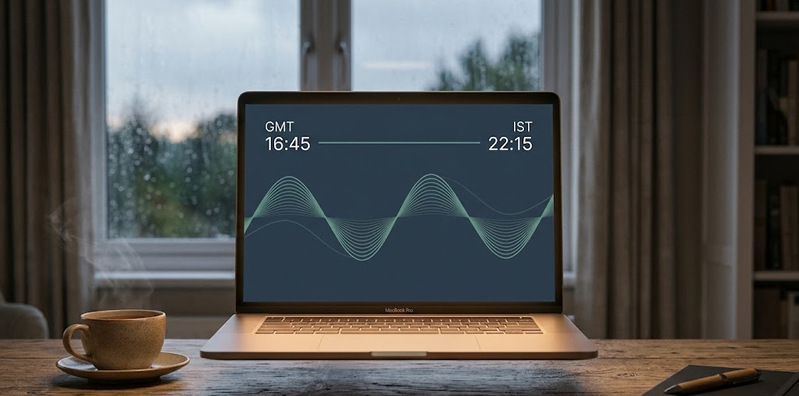
I'm based in Goa, India (IST, UTC+5:30). The UK is on GMT (UTC+0) in winter and BST (UTC+1) in summer. That's a 4.5 to 5.5 hour difference.
What this means practically:
- My afternoon is your morning. When it's 2:30 PM in India, it's 10:00 AM in the UK (GMT) or 9:00 AM (BST).
- My evening is your afternoon. When it's 7:00 PM in India, it's 2:30 PM GMT / 1:30 PM BST.
I offer extended-hours sessions specifically for UK clients. Typical UK appointment times are 10:00 AM – 5:00 PM GMT/BST. That covers your working day — you can have a session during your lunch break, or in the late afternoon after work.
For clients in Edinburgh or Glasgow, a 4 PM session is 9:30 PM for me. I've structured my practice around this deliberately.
What to Expect: Session Structure and Pricing
Transparency matters. Here's exactly how this works.
First Session: Assessment and Resourcing (60–90 minutes)
Your first full session is longer. We don't jump straight into trauma processing. Instead, we:
- Map your history: Not in exhaustive detail — just enough to understand what we're working with and identify target memories.
- Build internal resources: I'll guide you through creating grounding techniques and a felt sense of safety. If you have complex trauma or dissociation, we spend more time here. You cannot skip this step safely.
- Explain the process: I'll show you how bilateral stimulation works on screen, answer every question you have, and make sure you feel in control before we proceed.
This session costs £40 (60 mins) or £50 (90 mins) at the UK-friendly extended-hours rate.
Regular Processing Sessions (60 or 90 minutes)
Once we've done the groundwork, processing sessions follow. Each session includes:
- A brief check-in (how you've been since last time)
- Bilateral stimulation while we work through a target memory or theme
- Closing and grounding so you leave the session stable
Some clients prefer 60-minute sessions (£40). Others — especially those with complex trauma — find 90 minutes (£50) gives the nervous system enough time to fully process without feeling rushed. We'll figure out what works for you.
Pricing at a Glance
| Session Type | Duration | Cost (GBP) |
|---|---|---|
| Initial Consultation | 15 minutes | £5 |
| Extended Initial Consultation | 30 minutes | £8 |
| Standard EMDR Session | 60 minutes | £40 |
| Extended EMDR Session | 90 minutes | £50 |
Payment methods: Credit/debit card (via secure payment gateway), bank transfer, or PayPal. All transactions are processed in GBP. You'll receive an invoice after each session.
For comparison: The same 12-session course that costs £960–1,800 privately in the UK costs £480–600 through my practice. Same evidence-based protocol. Same clinical standards. Just delivered across a screen from a country where operating costs allow me to charge less.
Ready to Start?
Your first 15-minute video consultation costs just £5. No obligation, no pressure — just an honest conversation about whether this approach fits what you need.
Book a 15-Minute Consultation – £5Is Online EMDR Right for You?
Online EMDR works well for many people. It's not right for everyone. Let me be specific about both.
You're likely a good fit if:
- You've tried NHS talking therapy or private counselling and still feel stuck in the same patterns — hypervigilance, emotional flooding, numbness, intrusive memories.
- You carry complex trauma: childhood neglect or abuse, long-term relational trauma, multiple incidents over years. The kind of thing that doesn't resolve with six sessions of CBT.
- You're neurodivergent (ADHD, autism, AuDHD) and you've found that standard talk therapy doesn't work with your brain. EMDR is different — it doesn't require you to explain, analyse, or narrate the way talk therapy does.
- You live outside a major city and simply can't access an EMDR-trained therapist locally. This is incredibly common in the UK — Cornwall, the Highlands, rural Wales, Northern Ireland, the Lake District.
- You have a stable internet connection and a private space where you won't be interrupted for 60–90 minutes.
- You're motivated but exhausted. You've been reading, researching, trying to understand yourself. You know your patterns intellectually but they haven't shifted. That's not a failure — that's a sign that cognitive approaches alone aren't enough. You need something that works at the nervous-system level.
Online EMDR is not appropriate if:
- You are in acute crisis — actively suicidal, unable to keep yourself safe day to day. In this situation, you need in-person crisis support. The NHS crisis lines, your GP, or A&E are the right first step.
- You have active psychosis that is not well-managed. EMDR can sometimes be done with psychotic disorders when stabilisation is in place, but it requires careful coordination with your psychiatric team.
- You have severe dissociation (e.g., DID) and have not done prior stabilisation work. Dissociation is not a contraindication for EMDR — I work extensively with dissociative clients. But online work requires a certain level of grounding and co-consciousness that we'd need to assess first.
- You don't have any private space at home. Therapy requires being able to speak freely without worrying about being overheard. If you're in a houseshare with thin walls or living with someone who doesn't respect your privacy, we'd need to problem-solve this first.
If you're unsure which side of this you fall on, that's exactly what the 15-minute consultation is for. We'll talk through your situation honestly. If I don't think online EMDR is right for you, I'll tell you — and I'll suggest alternatives.
How to Start: Booking Your First Session
The process is straightforward and there's absolutely no pressure.
Step 1: Book a 15-minute video consultation (£5). You'll use my online scheduling system, which shows real-time availability in your local timezone. No back-and-forth emails trying to find a time that works.
Step 2: We meet on video. You tell me what's going on — as much or as little detail as you're comfortable with. I'll explain how EMDR works, answer your questions, and give you an honest assessment of whether this approach fits your situation.
Step 3: If you want to proceed, we schedule your first full session (60 or 90 minutes). If you don't, that's fine. There's no obligation. The consultation is a standalone conversation — not a sales pitch.
I treat this the way I'd want to be treated if I were sitting on the other side of the screen: direct, honest, no games.
Skip the NHS Wait. Start This Week.
View my real-time availability and book a 15-minute consultation. It's £5, it's confidential, and there's no obligation to continue. If you've been waiting months for trauma therapy, you deserve to know your options.
Book a 15-Minute Consultation – £5Frequently Asked Questions
Related Reading
• Can EMDR Therapy Be Done Online? What You Need to Know
• EMDR Therapy Cost: Complete Pricing Guide
• The Chameleon Disorder: Why CPTSD Gets Misdiagnosed for Decades
• EMDR for Anxiety: Does It Work?
• Why Your Therapist Isn't Helping (And What Actually Works for Trauma)
This article is for informational purposes only and does not constitute medical or therapeutic advice. EMDR therapy should only be provided by appropriately trained practitioners. Dr. Antonio D'Costa is an MD Pediatrician and EMDR therapist with EMDRIA-approved training. If you are in crisis, please contact your GP, NHS 111, or the Samaritans on 116 123 (free, 24/7).