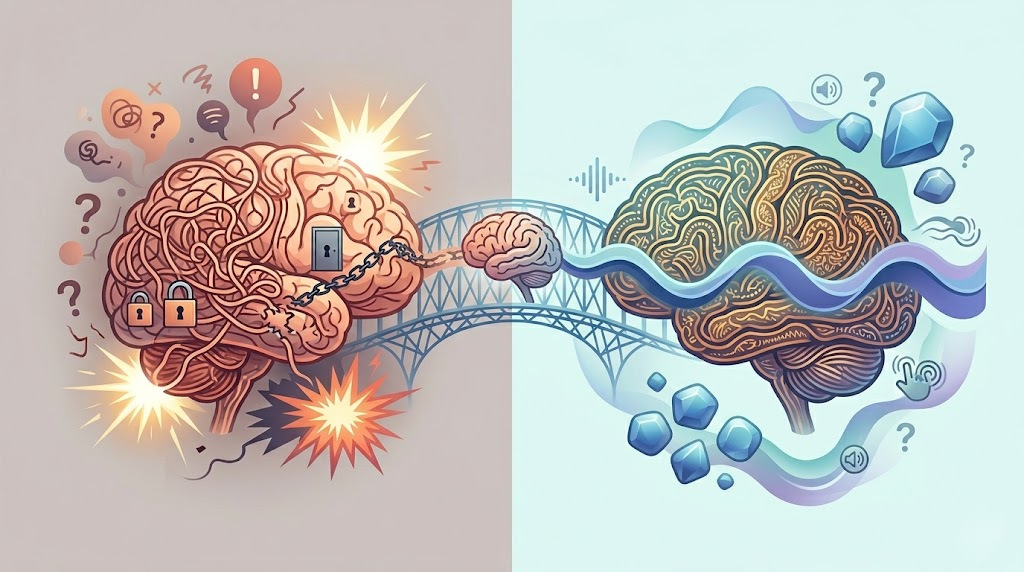
If you're an AuDHD adult who has tried therapy for trauma, anxiety, or depression only to feel stuck, misunderstood, or even worse—you're not alone. A common story in my practice is the client who says, "I've tried therapy before, but it never really clicked." Often, they've been through multiple therapists. The problem is rarely a lack of effort. The problem is that standard talk therapy is built for a neurotypical brain and often misses the unique wiring of an AuDHD mind.
This isn't to say all talk therapy is bad. But without neurodivergent-affirming adaptations, it can hit predictable barriers that leave trauma unresolved. The good news? There are effective alternatives. Eye Movement Desensitization and Reprocessing (EMDR) therapy is one powerful option that works with your neurodivergent brain, not against it.
📋 Quick Navigation: Your Questions Answered
Part 1: The 5 Core Reasons Talk Therapy Can Fail AuDHD Brains
Understanding why past therapy felt ineffective is the first step toward finding what works. These aren't personal failures; they are systemic mismatches.
1. The "Talking About Feelings" Wall
Many AuDHD individuals experience alexithymia (difficulty identifying and describing emotions) or have a cognitive, analytical style of processing. Traditional therapy that relies on linear, verbal emotional storytelling can feel impossible, frustrating, and can even trigger shutdowns or dissociation.
2. Executive Function Overload
Therapy itself requires massive executive function: scheduling consistent appointments, remembering to do homework, organizing nebulous thoughts into a coherent narrative week after week. For an ADHD brain, this can make therapy feel like another draining, impossible task to fail at, adding to shame rather than alleviating it.
3. Misinterpretation of Neurodivergent Traits
Without specific training, a therapist may pathologize autistic or ADHD traits. Stimming might be seen as anxiety, a special interest monologue as avoidance, flat affect as disengagement, or sensory overwhelm as panic attacks. This leads to treating the wrong thing and leaving the core trauma untouched.
4. Sensory & Body-Based Trauma Storage
AuDHD trauma is often stored sensorily and somatically—as overwhelming sounds, blinding lights, specific textures, or panic in the body—rather than as a neat narrative. Talk therapy, which operates in the cognitive realm, often can't reach or process these sensory flashbacks.
5. The Co-Morbidity Tangle
Trauma symptoms (hypervigilance, emotional dysregulation, executive dysfunction) overlap significantly with AuDHD traits. An untrained therapist may spend years treating what looks like "anxiety" or "depression" without recognizing the underlying neurodivergent structure or the traumatic roots of the distress.
Feeling Stuck in Traditional Therapy?
If you suspect you're AuDHD and past therapy hasn't helped, EMDR might offer a different path. Book a consultation to explore neurodivergent-affirming EMDR therapy.
Book a 15-Minute ConsultationPart 2: How EMDR Therapy Works *With* Your AuDHD Brain
EMDR is a structured, brain-based therapy designed to help the brain process and resolve traumatic memories. It's different because it doesn't require you to talk at length about the trauma or do weekly "homework." Here's why its framework can be a better fit:
It Bypasses the "Talking" Barrier
EMDR uses bilateral stimulation (like eye movements, tapping, or tones) while you briefly hold a memory in mind. This stimulation seems to engage the brain's natural adaptive information processing system, allowing it to digest the stuck memory without requiring a continuous, detailed verbal narrative. You don't need to find the perfect words.
Targets the Sensory Root
The protocol starts with identifying the worst part of a memory, which for AuDHD individuals is often a sensory fragment (a sound, a feeling in the body, an image). EMDR processes the memory directly at this sensory root, where it's actually stored, leading to more complete resolution.
Provides a Clear, Structured Container
The EMDR framework is predictable (8 phases). For brains that crave structure but struggle with open-ended tasks, this can be calming and containing. The work happens within the session, reducing the executive function demand outside of it.
Adaptable to Neurodivergent Needs
A trained therapist can adapt every step:
- Bilateral Stimulation: Can use tapping (tactile) or audio tones if eye movements are overwhelming.
- Preparation (Phase 2): We spend significant time building a "toolkit" of neurodivergent-friendly coping skills for emotional regulation—using sensory tools, movement, or special interests—to ensure you feel safe and grounded before processing.
- Processing Speed: We follow your brain's pace. Processing can be faster, slower, or more circular, and a knowledgeable therapist won't pathologize this.
| Therapy Approach | How It Works for AuDHD | Common Challenges |
|---|---|---|
| Traditional Talk Therapy | Relies on verbal emotional processing, linear storytelling, and abstract emotional concepts | Alexithymia, executive function demands, sensory memories inaccessible, neurodivergent traits misinterpreted |
| EMDR Therapy | Processes memories at sensory/body level, uses bilateral stimulation, structured protocol, adaptable to neurodivergent needs | Requires neurodivergent-affirming therapist, extended preparation phase, sensory adaptations |
Part 3: Important Considerations & Finding the Right Therapist
EMDR is Not a "Cure" for Neurodivergence
It's crucial to understand the goal. EMDR does not cure Autism or ADHD, nor should it try to. The goal is to resolve the traumatic memories and beliefs ("I'm broken," "I'm not safe," "I'm a failure") that are layered on top of your neurodivergence, often from years of trying to fit into a neurotypical world.
Success requires a therapist who understands both trauma and neurodivergence. The preparation phase is extended and tailored. The focus is on creating safety and agency, not forcing a standard protocol.
How to Find a Neurodivergent-Affirming EMDR Therapist
This is the single most important factor for safety and success.
Ask These Questions:
- "What is your experience working with autistic and ADHD clients?"
- "How do you adapt EMDR for sensory sensitivities or alexithymia?"
- "What does your preparation phase include for neurodivergent clients?"
- "Are you familiar with the overlap between trauma symptoms and AuDHD traits?"
| Green Flags ✅ | Red Flags 🚩 |
|---|---|
| Uses terms like "neurodiversity-affirming," mentions specific adaptations | Says "I treat everyone the same" or dismisses the need for adaptations |
| Understands sensory processing differences and alexithymia | Insists on eye movements only, dismisses tapping alternatives |
| Emphasizes extended preparation and safety over rapid processing | Wants to jump into trauma processing in first session |
| Recognizes that stimming, special interests, etc. are not pathology | Pathologizes neurodivergent traits as "resistance" or "avoidance" |
Could This Be the Missing Piece?
If you suspect you are AuDHD and have a history of trauma, or if you've felt frustrated by traditional talk therapy approaches, EMDR may offer a different way forward. It honors how your brain actually stores and processes information.
You are not "bad at therapy." You may just need a therapy designed for your brain.
Ready to Try a Different Approach?
If you're in India and suspect you're AuDHD with unresolved trauma, I invite you to schedule a consultation to explore if neurodivergent-affirming EMDR therapy might be right for you.
Book a ConsultationFrequently Asked Questions
Related Reading
• When ADHD Feels Like You're Drowning: Why Traditional Therapy Hasn't Worked
• How to Know If EMDR Is Working: Autism, ADHD & Alexithymia
• Why You Can't Say No: The Truth About People-Pleasing and Childhood Trauma
This article is for informational purposes only and does not constitute medical or therapeutic advice. Trauma therapy affects people differently. If you're experiencing significant distress, please consult with a qualified mental health professional. EMDR therapy should only be provided by appropriately trained practitioners. Dr. Antonio D'Costa is an MD Pediatrician. EMDR is an evidence-based specialized therapy for processing traumatic experiences and related emotional symptoms.