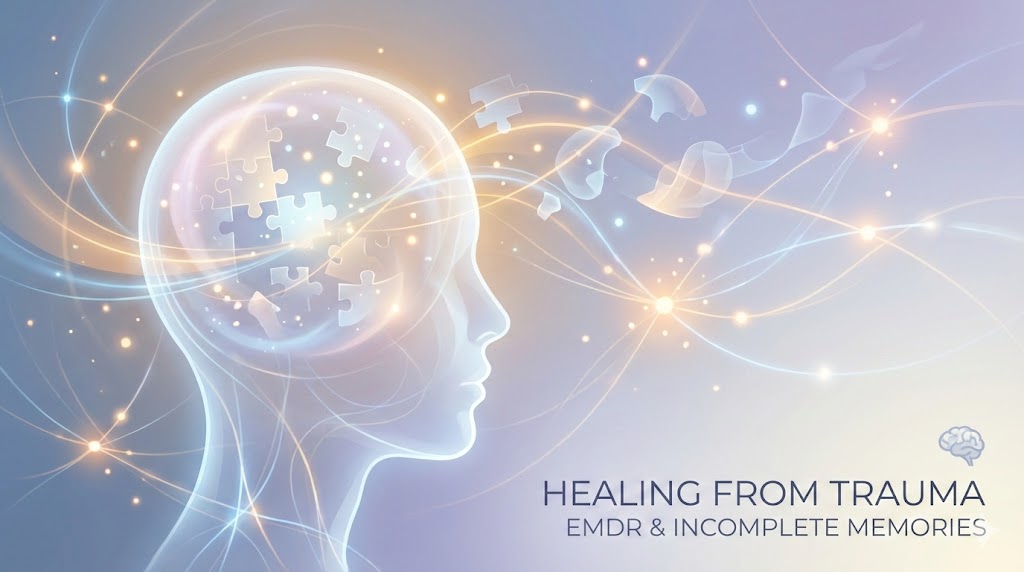
One of the most common reasons people hesitate to start EMDR therapy is the belief that they need to remember every detail of their trauma for it to work. You don't.
If you're struggling with anxiety, depression, emotional numbness, or unexplained physical symptoms but can't recall specific traumatic events—or your memories feel fragmented and incomplete—EMDR can still help you heal. This is exactly what EMDR therapy was designed for, and it's one of the reasons why it's so effective for complex trauma cases where dissociative amnesia is present.
📋 Quick Navigation
Why You Might Not Remember Your Trauma (And Why That's Normal)
When trauma happens, your brain's primary job is survival—not creating detailed memory files. The part of your brain responsible for storing memories in an orderly way (the hippocampus) essentially goes "offline" during overwhelming stress or trauma. Your nervous system floods with stress hormones, and your brain prioritizes getting you through the moment rather than recording it neatly for future recall.
Dissociative amnesia is your brain's protective mechanism. It's not a sign that something is wrong with you—it's proof that your brain did exactly what it needed to do to help you survive. This is especially common in cases of:
- Childhood trauma or abuse
- Complex PTSD from repeated traumatic events
- Sexual assault or violence
- Emotional neglect or attachment trauma
Your brain contained the trauma by dissociating those memories. That's not a barrier to healing—that's what EMDR is designed to work with.
How EMDR Works Without Clear Memories
Here's what makes EMDR different from traditional talk therapy: You don't need to consciously remember or verbally describe traumatic events in detail.
EMDR Works on Negative Cognitions, Not Individual Memories
Instead of requiring you to recall specific memories, EMDR targets the negative cognition—the core negative belief about yourself that formed because of the trauma. These beliefs sound like:
- "I'm not safe"
- "I'm powerless"
- "I'm not good enough"
- "I can't trust anyone"
- "It was my fault"
You don't need to remember the specific event that created this belief for EMDR to reprocess it. We work with whatever memory you do have access to—whether it's the first incident you recall, the worst one, or the most recent. That becomes your entry point.
Your Brain Knows Where to Go
Once we begin processing with bilateral stimulation (the guided eye movements or taps used in EMDR), something remarkable happens: your mind, through free association, automatically goes back to where it needs to go.
You don't have to force yourself to remember. You don't have to consciously bring up memories or emotions. Your brain instinctively knows what needs healing, and the bilateral stimulation helps unlock and process those implicit memories—the emotions, body sensations, and beliefs stored below your conscious awareness.
This is how EMDR can work even when:
- Your memories feel foggy or incomplete
- You remember feelings but not events
- You have physical symptoms (tightness in chest, panic, nausea) without understanding why
- You've experienced dissociative amnesia and have memory gaps
What Actually Gets Processed in EMDR
EMDR doesn't require you to access explicit memories (like remembering the exact date, location, or sequence of events). Instead, it works with what's already present in your nervous system:
Body sensations: That tightness in your chest when you feel scared, the tension in your shoulders, the knot in your stomach
Emotional responses: Sudden waves of fear, shame, sadness, or anger that feel disproportionate to current situations
Negative beliefs: The automatic thoughts about yourself that feel deeply true even when logically you know they're not
Behavioral patterns: Fawning, people-pleasing, hypervigilance, emotional shutdown, avoidance
These are implicit memories—and EMDR helps your brain reprocess them even without a clear narrative or detailed recollection.
Relieved You Don't Have to Force the Memories?
You don't need a perfect timeline of your trauma to start healing. If you're looking for an EMDR therapist who knows how to safely process implicit memories and body sensations without forcing you to dig up or re-live the details, let's talk.
Book a 15-Minute Consult (₹400 / $10)What to Expect When Emotions Surface During EMDR
Here's what's important to understand: When processing begins, emotions that were previously dissociated can surface. Yes, that can feel intense. In fact, it's one of the reasons your brain dissociated those memories in the first place—to protect you from being overwhelmed.
But this is where Phase 2 of EMDR therapy becomes crucial.
Before any trauma processing begins, your therapist should spend adequate time in the Preparation and Stabilization Phase, teaching you:
- Emotion regulation techniques
- Grounding exercises to bring you back to the present moment
- Coping strategies for managing intense feelings
- Self-soothing skills you can use both in and outside of sessions
These skills become your toolkit. They ensure that when difficult emotions do come up during processing, you know exactly how to manage yourself. You're never left alone with overwhelming feelings—you have concrete tools to regulate your nervous system.
With complex trauma and dissociation, this preparation phase is even more important and should not be rushed. A good EMDR therapist will take the time needed to make sure you feel safe, stable, and equipped before moving into reprocessing.
Why This Matters for People Who "Can't Remember"
If you've been avoiding therapy because you thought you needed clear memories to heal, you can let go of that belief now.
EMDR's effectiveness doesn't depend on your ability to consciously recall trauma. It depends on your nervous system's ability to reprocess what's been stored—and that happens whether you have detailed memories or not.
Research consistently shows that EMDR produces faster results than traditional talk therapy, with many clients experiencing significant relief within 6-12 sessions. For single-trauma cases, studies report that 100% of participants experienced complete relief from PTSD symptoms after just 6-8 EMDR sessions, while 77% of multiple-trauma survivors also achieved complete symptom resolution.
You don't need a perfect memory to begin healing. You just need a starting point.
Is EMDR Right for You?
EMDR may be helpful if you're experiencing:
- Anxiety, depression, or emotional numbness with unclear origins
- Physical symptoms (panic attacks, chronic pain, digestive issues) without medical explanation
- Behavioral patterns that don't make sense to you (avoidance, hypervigilance, people-pleasing)
- A sense that "something happened" even if you can't remember what
- Fragmented memories or flashbacks without context
- Difficulty trusting others or feeling safe in relationships
The good news: EMDR doesn't require you to have all the answers before you start. That's what the therapy is designed to help you uncover—safely, at your own pace, with the right support.
Ready to Explore Whether EMDR Is Right for You?
If you've been hesitant about starting EMDR because of memory gaps or dissociative amnesia, I want you to know: your brain's protective response doesn't disqualify you from healing. It's exactly the kind of case EMDR was designed to address.
Not sure where to start? I offer brief exploratory consultations to help you understand whether EMDR is the right fit for your situation. This is a comfortable conversation—not a therapy session—where we talk about what you're experiencing, answer your questions about how EMDR works, and create a plan together.
You will not process traumatic memories in this first consultation. We focus on getting to know each other, building trust, and making sure you feel safe and informed before any healing work begins.
Ready to Heal Without Perfect Memories?
Book a consultation to discuss how EMDR therapy can help, or schedule a 60-minute EMDR therapy session.
Book Your Consultation NowFrequently Asked Questions
Related Reading
• EMDR 8 Phases Explained: Complete Therapy Guide
This article is for informational purposes only and does not constitute medical or therapeutic advice. Trauma affects people differently. If you're experiencing trauma symptoms, please consult with a qualified mental health professional. EMDR therapy should only be provided by appropriately trained practitioners. Dr. Antonio D'Costa is an MD Pediatrician. EMDR is an evidence-based specialized therapy for processing traumatic experiences and related emotional symptoms.