This article is for English speakers living in South Korea — teachers, professionals, military personnel, expats — who need specialist trauma therapy but are navigating a country where finding English-speaking mental health services, particularly EMDR, is genuinely difficult. Online delivery solves the language and access barriers completely.
Living in South Korea as an English speaker comes with specific challenges. The work culture — whether you're teaching at a hagwon, working in a corporate office in Seoul, or stationed at a military base — is demanding by any standard. The language barrier makes everyday tasks harder, including finding healthcare. And if what you need isn't a general practitioner but a specialist trauma therapist, the options narrow dramatically.
If you've been searching for EMDR therapy in Korea and hitting dead ends — therapists who don't speak English, waitlists that stretch for weeks, or simply no one trained in trauma processing in your area — this article is for you.
Online EMDR with a qualified trauma therapist, in English, at a clear USD rate, fitting around a Korean work schedule.
📋 Quick Navigation
Mental Health Services in South Korea: The English-Speaker's Gap
South Korea has been making strides in mental health awareness. The stigma — while still present — is gradually shifting, especially among younger generations. Seoul has international clinics and a growing number of mental health professionals.
But here's the reality for English speakers: finding a therapist who speaks fluent English and is trained in EMDR specifically is extremely difficult. Most mental health services in Korea are delivered in Korean. The international clinics in Seoul, Busan, and Incheon typically offer general counselling or psychiatry — not specialist trauma therapy like EMDR. And even when you find someone, cultural context matters. Approaches to therapy that work well for Korean clients may not translate to someone who grew up in a Western context with different family dynamics, different expectations around emotional expression, and different trauma histories.
The expat-specific pressures compound this. English teachers working split shifts with limited downtime. Corporate professionals navigating one of the most hierarchical work cultures in the developed world. Military personnel managing operational stress far from home. The need for trauma-informed care is real. The local supply of English-speaking EMDR therapists hasn't kept pace.
Online EMDR removes the language barrier, the geography problem, and the cultural mismatch. You work with someone who speaks your language fluently, understands the expat experience, and delivers the same evidence-based protocol regardless of where you're sitting.
Why Online EMDR Works for Clients in Korea
The evidence for remote EMDR is consistent. McGowan et al. (2021) in BMC Psychiatry evaluated internet-delivered EMDR and found outcomes comparable to in-person treatment. A 2023 systematic review across 16 studies and over 1,200 participants confirmed online EMDR as a feasible, effective alternative. A 2024 Cardiff University service evaluation found no difference in therapy completion, drop-out rates, or safety between online and in-person delivery.
How a Session Works Over Video
EMDR's core mechanism is bilateral stimulation — rhythmic left-right input (visual or tactile) that activates your brain's natural memory reprocessing. The full 8-phase protocol applies whether we're in the same room or separated by the East China Sea.
In your session: I share my screen and you follow a moving visual target with your eyes, or I guide you through self-administered tapping. Your webcam lets me monitor your responses. The processing is in your nervous system — the screen is just the delivery channel.
What you need: Korea's internet infrastructure is among the best in the world — this will not be a problem. A laptop or tablet with webcam, headphones for privacy, and a quiet room for 60–90 minutes. If you're in a goshiwon or studio apartment, headphones and a do-not-disturb sign on the door handle work fine.
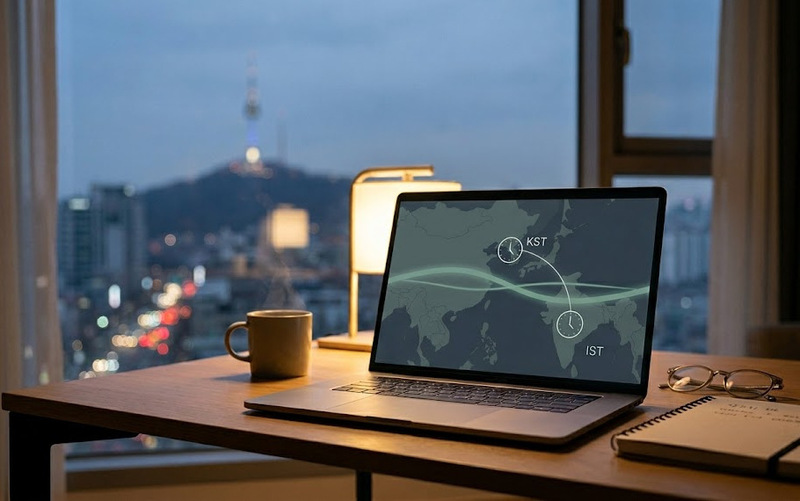
The Time Zone: KST ↔ IST
South Korea (KST, UTC+9) is 3.5 hours ahead of India (IST, UTC+5:30). No daylight saving — Korea stays on KST year-round, so the calculation never changes.
| Your Time (KST) | My Time (IST) | Works For |
|---|---|---|
| 6:00 PM | 2:30 PM | After work / after hagwon |
| 7:00 PM | 3:30 PM | Post-dinner session |
| 8:00 PM | 4:30 PM | Evening session |
| 10:00 PM | 6:30 PM | Late evening (last slot) |
Your evening maps neatly to my afternoon. Finish your classes, leave the office, or wrap up your shift — and do a session in the evening quiet. I'm fully present, mid-afternoon in Goa. My scheduling system shows everything in KST automatically.
Session Structure and Pricing
Transparency first.
First Session: Assessment and Resourcing (60–90 minutes)
We don't jump into processing. Your first full session covers: mapping your history efficiently, building grounding resources so processing is safe, and demonstrating bilateral stimulation so you know exactly what to expect. For complex trauma, we may spend more time on resourcing. This is not delay — it's the foundation.
$50 (60 mins) or $75 (90 mins).
Regular Processing Sessions (60 or 90 minutes)
Each session includes a check-in, bilateral stimulation work, and a proper closing. 60 minutes ($50) works for many. 90 minutes ($75) gives complex trauma more room.
Pricing at a Glance
| Session Type | Duration | Cost (USD) |
|---|---|---|
| Initial Consultation | 15 minutes | $12 |
| Extended Consultation | 30 minutes | $20 |
| Standard EMDR Session | 60 minutes | $50 |
| Extended EMDR Session | 90 minutes | $75 |
Payment: Credit/debit card via secure gateway, bank transfer, or PayPal. Korean-issued international cards accepted. All transactions in USD. Invoice after each session. No packages — pay per session.
Ready to Start?
Your first 15-minute video consultation costs $12. Private, confidential, no obligation. English-speaking trauma therapy that fits your life in Korea.
Book a Consultation – $12Is Online EMDR Right for You?
It works for many. Not everyone.
You're likely a good fit if:
- You're an English speaker in Korea — teacher, professional, military, student, expat — who needs therapy in English and can't find a specialist trauma therapist locally.
- You carry complex trauma: childhood experiences, developmental trauma, long-term relational patterns. The kind of thing that doesn't resolve with surface-level strategies.
- You're neurodivergent (ADHD, autism, AuDHD) and talk therapy hasn't worked. EMDR operates at the nervous-system level — it doesn't require you to explain or analyse.
- You work demanding hours and need therapy that fits around hagwon shifts, office overtime, or military duties. Evening sessions in KST map well.
- You value privacy. Online therapy from outside Korea means zero overlap with your social circle, workplace, or local community.
Online EMDR is not appropriate if:
- You are in acute crisis — actively suicidal, unable to stay safe. In Korea, contact the 24-hour crisis hotline at 1393 (Korea Suicide Prevention Center), dial 119 for emergency services, or visit the nearest hospital emergency department.
- You have active psychosis that is not well-managed.
- You have severe dissociation without prior stabilisation.
- You don't have a private, uninterrupted space for 60–90 minutes.
Unsure? The consultation is an honest conversation about fit. If online EMDR isn't right for you, I'll say so directly.
Getting Started
Simple. No pressure.
Step 1: Book a 15-minute video consultation ($12). My scheduling system shows real-time availability in KST.
Step 2: We meet on video. You tell me what's happening — in as much or as little detail as you want. I explain EMDR, demonstrate bilateral stimulation, and answer your questions.
Step 3: If you want to proceed, we schedule your first full session. If not, no obligation.
Private. English-Speaking. Fits Your Schedule.
View real-time availability in KST and book a confidential 15-minute consultation. $12. No language barrier. No commitment beyond the first conversation.
Book a Consultation – $12Frequently Asked Questions
Related Reading
• Can EMDR Therapy Be Done Online? What You Need to Know
• EMDR Therapy Cost: Complete Pricing Guide
• The Chameleon Disorder: Why CPTSD Gets Misdiagnosed for Decades
• EMDR for Anxiety: Does It Work?
• EMDR for Autism, ADHD & Alexithymia
This article is for informational purposes only and does not constitute medical or therapeutic advice. EMDR therapy should only be provided by appropriately trained practitioners. Dr. Antonio D'Costa is an MD Pediatrician and EMDR therapist with EMDRIA-approved training. If you are in crisis in South Korea, contact the 24-hour crisis hotline at 1393 (Korea Suicide Prevention Center), dial 119 for emergencies, or visit the nearest hospital emergency department.