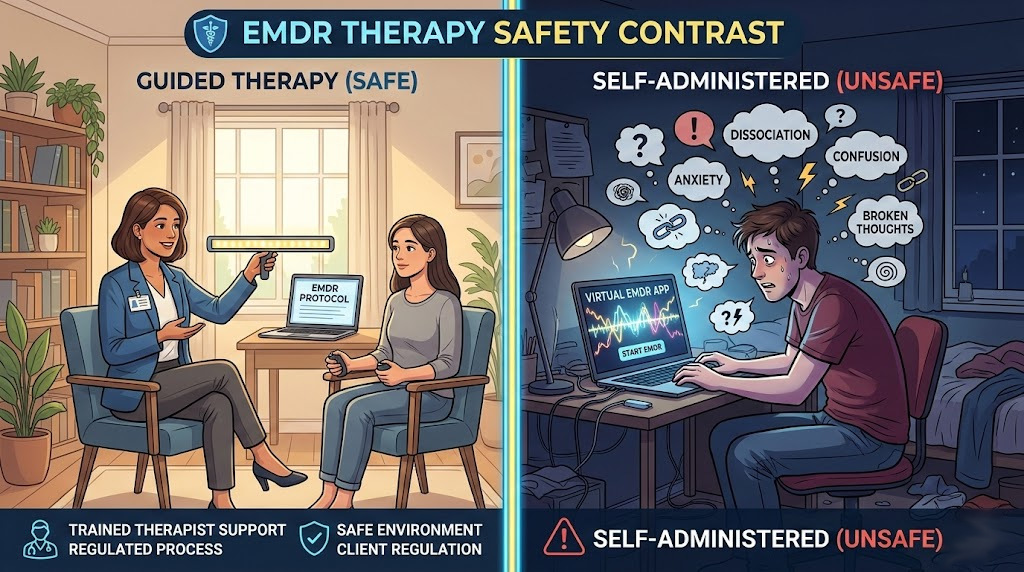
As an EMDR therapist, I encounter this question daily: "Can you do EMDR at home?" The short answer is no, and here's why—with critical warnings about the dangerous trend of virtual EMDR platforms that promise healing but deliver risk instead.
The 8-Phase EMDR Protocol: Why Skipping Steps Is Dangerous
EMDR therapy is not just bilateral stimulation (BLS)—it's an eight-phase protocol developed by Francine Shapiro that requires careful clinical judgment. When apps and online platforms advertise "EMDR at home," they're typically offering just one component (phase 4: desensitization) without the essential preparatory and safety phases that make EMDR effective and safe.
The most critical missing component in DIY EMDR is Phase 2: Preparation, which includes extensive grounding and stabilization techniques. As I explain to my clients: EMDR works in two directions—building your ability to handle difficult emotions (grounding/regulation) while decreasing trauma intensity (processing). Skipping grounding is like rowing with one oar—you'll go in circles or capsize completely.
📋 Quick Navigation
The Scam of Virtual EMDR Platforms
Recent investigations have revealed concerning trends in mental health apps, including virtual EMDR platforms that slap bilateral stimulation on random protocols and call it EMDR therapy. These apps often lack proper clinical oversight and ignore essential safety protocols.
What These Platforms Dangerously Omit:
- Comprehensive assessment (Phase 1): No evaluation of trauma history, dissociation risk, or current stability
- Proper preparation (Phase 2): Minimal or no grounding exercises
- Resource development (Part of Phase 2): No building of internal resources for difficult moments
- Clinical judgment: No therapist to recognize when to pause, adjust, or stop processing
- Closure procedures (Phase 7): No proper session completion to ensure stability
- Reevaluation (Phase 8): No follow-up assessment of progress or complications
Concerned About Virtual EMDR Platforms?
Schedule a consultation to learn about safe, ethical EMDR therapy with proper grounding and professional oversight.
Book Safe EMDR ConsultationThe Real Risks of At-Home EMDR
When trauma processing occurs without proper grounding and clinical oversight, the results can include dissociation, retraumatization, and even psychosis in vulnerable individuals. I've personally worked with clients who experienced severe setbacks from attempting DIY EMDR or using unsupervised virtual platforms.
Specific Dangers Include:
- Increased dissociation: Without proper grounding, the nervous system can't handle trauma processing
- Retraumatization: Unprocessed material surfaces without support systems
- Emotional flooding: Intense emotions without regulation skills
- Psychiatric decompensation: Particularly concerning for those with complex trauma or neurodivergence
- False sense of completion: Believing trauma is "processed" when it's merely activated
- Dependency on BLS: Using bilateral stimulation as a coping mechanism rather than achieving true healing
- Missing core material: Without clinical guidance, you might process surface memories while leaving core traumas untouched
Grounding: The Non-Negotiable Foundation
For clients with complex trauma or neurodivergent conditions (ADHD, autism, etc.), grounding requires significantly more than 1-2 quick exercises. In my practice, I won't begin trauma processing until clients can regulate themselves and maintain their window of tolerance for at least 5-10 minutes after grounding exercises.
Essential Grounding Skills That Virtual Platforms Miss:
- Somatic awareness techniques: Connecting with bodily sensations safely
- Container exercises: Learning to contain overwhelming emotions
- Safe place development: Creating internal havens for regulation
- Resource tapping and installation: Building internal strength and resilience
- Interoceptive awareness building: Developing awareness of internal states
- Breathing and regulation skills: Multiple techniques for different emotional states
- Visualization techniques: For those who respond well to imagery
| Professional EMDR Therapy | Virtual EMDR Platforms |
|---|---|
| 8-phase protocol with all components | Typically only bilateral stimulation |
| Comprehensive trauma assessment | No clinical assessment |
| Extensive grounding preparation | Minimal or no grounding |
| Clinical judgment for pacing | One-size-fits-all approach |
| Proper closure procedures | No stabilization at session end |
| Follow-up and reevaluation | No progress assessment |
| Customized for individual needs | Generic protocols for all users |
What About Butterfly Hugs and Bilateral Stimulation?
The butterfly hug—a self-administered bilateral stimulation technique—can be helpful for relaxation and distress tolerance when used appropriately. However, this is not EMDR therapy. It's a coping skill that may provide temporary relief without addressing underlying trauma.
Important distinction: Bilateral stimulation might help you reach a core memory, but only EMDR with a trained provider ensures you can safely process and heal that memory. Dependence on BLS for relief is coping, not therapy.
When Bilateral Stimulation Can Be Helpful:
- As a relaxation technique between professional sessions
- For distress tolerance in non-traumatic situations
- When guided by a therapist for specific purposes
- As part of a comprehensive treatment plan
When Bilateral Stimulation Is Dangerous:
- As a substitute for professional EMDR therapy
- For processing traumatic memories without support
- When dissociation risk hasn't been assessed
- Without proper grounding and stabilization
Worried About Unsupervised EMDR?
Get professional guidance on safe trauma processing. Book a consultation to discuss proper EMDR therapy.
Schedule Professional ConsultationSafe Alternatives to At-Home EMDR
If you're seeking emotional support between sessions or can't access professional EMDR, consider these safer alternatives:
- Self-guided grounding exercises: Meditation apps with body scans, breathing techniques, and mindfulness practices
- Journaling: Processing emotions through writing without trauma activation
- Support groups: Peer support with professional facilitation
- Therapeutic movement: Yoga, tai chi, or walking meditation
- Professional-guided resources: Books and workbooks designed by EMDR therapists
- Traditional talk therapy: For processing emotions with professional support
- Skills-based therapies: DBT, CBT, or ACT for emotion regulation
How to Identify Ethical EMDR Therapy
Red Flags to Watch For:
- Platforms promising "quick trauma healing" or "instant results"
- Apps claiming to replace professional therapy entirely
- Providers who skip comprehensive assessment
- Anyone minimizing the importance of grounding and preparation
- Lack of discussion about dissociation risks
- No closure procedures or stabilization plans
- One-size-fits-all approaches to complex trauma
Green Flags for Quality EMDR:
- Therapist emphasizes Phase 2 preparation and grounding
- Regular assessment of your window of tolerance
- Clear safety protocols and emergency plans
- Ongoing evaluation of dissociation risk
- Integration of grounding throughout treatment
- Appropriate pacing based on your capacity
- Transparent discussion of risks and benefits
- Proper certification and ongoing training
The Bottom Line: Safety Over Convenience
The rising popularity of virtual EMDR platforms represents a concerning trend where profit is prioritized over patient safety. While technology can enhance accessibility to mental health care, it cannot replace the clinical judgment, human connection, and safety protocols that ethical trauma therapy requires.
If You're Considering EMDR, Please:
- Seek a qualified EMDR therapist with proper training and certification
- Ask about their grounding protocols and safety measures
- Be wary of any platform promising EMDR without professional oversight
- Remember that healing takes time—there are no shortcuts with trauma
- Trust professional judgment over marketing claims
- Prioritize safety over convenience or cost savings
Your nervous system deserves proper care, not risky shortcuts. True healing happens in relationship with a skilled professional who can navigate the complexities of trauma with you, ensuring safety every step of the way.
The choice between professional EMDR therapy and DIY approaches isn't just about effectiveness—it's about safety, ethics, and preventing harm. When it comes to trauma work, the stakes are too high to gamble with your mental health.
Frequently Asked Questions
Related Reading
• Understanding Blended Beliefs: When Parts of You Hold Different Truths
• Stuck in Therapy? Understanding Memory Blocks in EMDR
• What Really Happens During & After EMDR: Abreactions & Hangovers
This article is for informational purposes only and does not constitute medical or therapeutic advice. Trauma therapy affects people differently. If you're experiencing significant distress, please consult with a qualified mental health professional. EMDR therapy should only be provided by appropriately trained practitioners. Dr. Antonio D'Costa is an MD Pediatrician. EMDR is an evidence-based specialized therapy for processing traumatic experiences and related emotional symptoms.