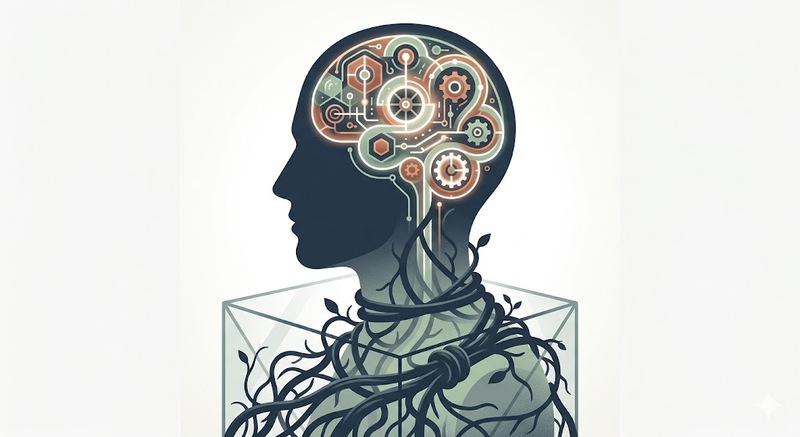
I thought I'd address this today because my intake forms had about 5 clients who used this exact phrase in just the last 2 weeks: "I know exactly why I am like this, so why am I still stuck?"
So, these clients—they're in this brutal trap. They've read the books (The Body Keeps the Score is a popular one), some even know their attachment style and can name the pattern, a few others can also map out exactly how their parents' unresolved issues created their triggers. They have very good intellectual insight into their trauma... but still... nothing is changing.
They've tried talk therapy, CBT, psychoanalysis, yoga, meditation...
But they still dissociate, still go completely numb or shutdown, still rage out. The executive dysfunction is crushing—you "know better," but you still can't "do better."
📋 Quick Navigation
The Trap of Intellectualizing Trauma
The way I see this is... it's not about failing. It's about trying to solve a core nervous system survival programmed response at the conscious, logical, thinking prefrontal cortex level.
For a lot of people, intellectualizing trauma is a brilliant survival skill (I've written on this before). Growing up in chaotic, abusive, or emotionally empty environments, our brains learned: If I can just analyze the threat, if I can figure out exactly WHY they are acting this way, I can predict it and stay safe.
Pattern recognition became the armor. It kept them alive.
But now, that exact same armor steps in to protect them from actually feeling the raw emotion. Because to a dysregulated nervous system, feeling that original pain feels like dying—I mean to say that it sees it as a threat to survival, highly uncomfortable.
Why Talk Therapy Hits a Brick Wall
This is exactly why standard CBT or talk therapy eventually may hit a brick wall for CPTSD. For those who have read that book by Kolk (which I'm not a great fan of, btw, owing to the questionable take on CSA and other topics especially), he puts it this way: Talk therapy is a "top-down" approach.
It's great for cognitive reframing. But when you're dealing with chronic emotional numbness or dorsal vagal shutdown (that deep "freeze" state), just talking about the trauma actually becomes a high-level form of avoidance. You end up talking in circles for years without ever moving the physical charge out of your body.
Is Your Nervous System Stuck in a Loop?
If you have high insight but still feel physically and emotionally stuck, it's time to bypass the intellect. Book a consultation to see if EMDR can help you process what talk therapy hasn't.
Schedule a ConsultationThe Solution: "Bottom-Up" Processing
To actually break the loop, the work has to go "bottom-up."
You don't need more insight. You have plenty of insight. You need to bypass the intellect and start working with how your body is physically holding that survival energy. Whether that's through somatic experiencing, EMDR, or parts-work (IFS), the goal isn't to figure out the "why" anymore. The goal is to give your nervous system the visceral experience of safety in the present moment—so it can finally turn off the alarms from 15 years ago.
This is one of those reasons retraining emotional vocabulary and somatic experiences becomes very important in EMDR resourcing and processing sessions. The reason I wrote this is to stress that in such clients, it may (ironically) work well to ask them NOT to use thoughts—keep them aside and work with just feeling emotions and sensations (after good resourcing).
Give yourself a break... it's not because of a lack of willpower... it's because you need to target a different system altogether.
Rethinking Pop Psychology Theories
PS: As much as I refer to theories and concepts like Polyvagal and the Window of Tolerance, or even pop psychology books, I do this not because they are completely scientifically unassailable (the theories have some substance to them, don't get me wrong), but because it helps clients form a bridge from knowing about trauma to understanding trauma and human biology.
I've been doing a lot of personal research to find psychological theories that are much more scientifically and biologically sound (I come from a medical background), AND ALSO highly accessible to clients (who are in distress, at times already with cognitive overload from trauma). I'm yet to find one to replace much of the theories I base my writeups on. So, keep that in mind, for whoever likes technicalities...
Frequently Asked Questions
Related Reading
• EMDR vs. Talk Therapy: Research Shows Brain Changes
• Why You Feel Stuck in Therapy (Memory Blocks)
• The Chameleon Disorder: Why CPTSD Gets Misdiagnosed for Decades
This article is for informational purposes only and does not constitute medical or therapeutic advice. Trauma therapy affects people differently. If you're experiencing significant distress, please consult with a qualified mental health professional. EMDR therapy should only be provided by appropriately trained practitioners. Dr. Antonio D'Costa is an MD Pediatrician. EMDR is an evidence-based specialized therapy for processing traumatic experiences and related emotional symptoms.